Friday, 18 July 2008

Jane Austen Quote – Week 13


As Jane Austen’s most famous novel is Pride & Prejudice, I decided to pull out this quote to commemorate her passing away this 18 July. So it goes, as the studious Mary Bennet commented on Mr. Darcy:

“Vanity and pride are different things, though the words are often used synonimously. A person may be proud without being vain. Pride relates more to our opinion of ourselves, vanity to what we would have others think of us.”(PP, volume I, chapter 5).

Hmm… I’m ambivalent with Jane Austen’s definition of pride and vanity, because I have formed my own over the years (see below). I know, I know… it’s the first time I argue with what Jane wrote. It’s ironic that I should say so. But I think this blog is a free media where we can debate our dearest Jane Austen herself, not for debate sake, but for a healthy understanding.

And you know what? Many people will bash me for this; but I often think that Fitzwilliam Darcy often treaded on the definition of ‘vanity’ instead of ‘pride’ (well, not a secret here. My number one Austen hero is actually Mr. Knightley, not Mr. Darcy. Okay, sue me, but give me time to hide!)

I still recall what Darcy said to Elizabeth as he tried to propose her for the first time. He spoke of his affection to her whilst at the same time acknowledging her inferiority to his status. Why, I can understand why Lizzy kicked him out of the house! Really, Darcy and Mr. Thornton of the North & South should swap notes on how to charm smart independent ladies! Check this out!

Let’s see what Dictionary.com says about the two things:

Pride: a high or inordinate opinion of one's own dignity, importance, merit, or superiority, whether as cherished in the mind or as displayed in bearing, conduct, etc.

Vanity: excessive pride in one's appearance, qualities, abilities, achievements, etc.; character or quality of being vain; conceit: Failure to be elected was a great blow to his vanity.

Anyway, there is a very fine line between pride and vanity, so fine and thin that we usually fail to detect it. But it’s important to me to check whether at one point I’m experiencing pride or vanity. Hence, my indication is that:

1) If I’m ‘just’ proud of myself or someone or something, with a warm feeling inside because of what I/he/she/that something did/said, that’s pride. A warm feeling to acknowledge that it was truly something to be done/said, or that the state one’s in is truly something worth praising

2) But if I then compare such action/statement with someone else’s, saying that mine/his/hers is incomparably better than that someone else, then there’s red alert there. It’s possible that it’s not pride that I have. It’s vanity instead

3) Vanity can be shaken or blown by failure. Yet, it’s harder to destroy pride. Pride is the ability to walk with head straight despite our failure or defeat; for we know that we’ve done our best, and nothing is wasted

Hence, I’m sorry to say this, but to me Mr. Darcy’s accounts are often on the verge of vanity, hence he needed Elizabeth Bennet to balance him. Just like Emma Woodhouse. Her excessive pride of herself made her insensitive towards Miss Bates, hence George Knightley needed to rebuke her.

But Fanny Price would be someone I put directly into ‘pride’. She has her own pride that guides her through all the troubles, despite Mrs. Austen labeling her as ‘insipid’.

Of course, this is my 21st century definition of pride and vanity. Yours might be different. Thoughts?

Pic: A very nice water-colour picture of Darcy and Lizzy by Jane Odiwe

Quiz to commemorate Jane Austen’s death anniversary

Dearest friends,

This Friday, 18 July, exactly 191 years ago, Jane Austen left this world. I understand that some fans are not comfortable with the commemoration of Jane’s death, and we honor their views. But for many, Jane’s death is also an important event to remember, for it is the day where the famous authoress, the strong, witty, and amazing woman we know, left us for good. Physically, but not at heart.

In accordance, we would like to conduct another quiz for Jane Austen fans (and also Jane/Tom fans). The winner will have a copy of the great-read ‘Confessions of a Jane Austen Addict’ sent to her/his abode by none other than the authoress of the book herself, Laurie Viera Rigler (thanks a lot Laurie!). The questions are as followed:

  1. In addition to writing about love stories (and their predicaments), Jane Austen was also an avid supporter of the abolitionist movement. In what novel did she include slavery as one of her main themes?

  1. Who accompanied Jane Austen to Winchester on 24 May 1817?

  1. Years after Jane Austen’s death, Thomas Langlois Lefroy admitted to one of his relatives that he used to have a ‘boyish love’ with the famous authoress. What was the name of his relative, and what was he to Tom Lefroy?

How to join? Just answer the three questions and send the answers to Icha (tara_parvati@yahoo.com) AND Rachel (rachkingston@aol.com). DON’T reply to the comment section, unless you want your answers copied by others.

Deadline: Thursday, 31 July 2008 at 24:00 GMT (the midnight between Thursday and Friday). If you’re not sure, visit http://www.timeanddate.com/ or http://www.timezoneconverter.com/ to check your time zone.

The winner will be announced on 2 August 2008 at the latest and he/she will get a copy of the ‘Confessions of a Jane Austen Addict’ shipped to his/her address wherever that is, so long as it’s on Earth.

Pic: ‘Confessions of a Jane Austen Addict’ by Laurie V. Rigler

Saturday, 12 July 2008

Jane Austen Quote of the Week 12

I am so torn this week - I have a handful of amazing quotes to post - but I have decided to go with Mary Crawford and Mansfield Park.


“My dear Miss Price,” said Miss Crawford, as soon as she was at all within hearing, “I am come to make my own apologies for keeping you waiting; but I have nothing in the world to say for myself-I knew it was very late, and that I was behaving extremely ill; and therefore, if you please, you must forgive me. Selfishness must always be forgiven, you know, because there is no hope of a cure.” - Mansfield Park, (Penguin Red 2006), Volume I, Chapter 7, Page 70.

Not to be on a moral soapbox here, for I have hundreds of vices of my own, but there are two vices I particularly hate - nastiness and selfishness. Nastiness, because deliberate intention to hurt other people is just evil, and acute selfishness because it unnecessarily impacts so many people.
I love Mary's "selfishness must always be forgiven, you know, because there is no hope of a cure". This is so interesting! As a rule of thumb I have always thought that truly selfish people do not realise they are selfish, or the extent of their selfishness and its effect on others. I wonder if Mary is jokingly acknowledging she is "cutely selfish" without realising the full extent of her self-centeredness? What do you think?

As for "no hope of a cure", this I agree with. 1) If a selfish person does not realise their selfishness, why would they change? 2) Of course, anyone can change, but they have to want to themselves - no earthly person can make them change. So then you can have the cycle of person #1 telling #2 they are selfish, and number #2 denies it ... and so it goes. But of course, there are exceptions to everything. The above scenario is what I have personally observed over and over agin, and so Mary's quote really rang true. :)

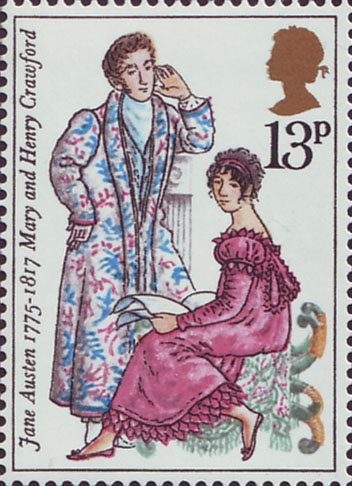
Pic: Mary & Henry Crawford Stamp from: Collect GB Stamps

Trivia Quiz

I thought that it would be nice to do a 20-question trivia quiz for our faithful fans who love the film, Becoming Jane, as much as us.

Icha will be doing one of her more difficult, speciality set of questions (with prize) in commemoration of the death of Jane Austen on the anniversary date of 18th July.

Until then, I thought I would keep you occupied with this one.....Enjoy!


Answers will be posted this time next week.

1. Of the following characters, who was fictional and who existed:
- Mrs Ann Radcliffe
- Mr Wisley
- Henry Austen
- Cousin Eliza de Feuillide
- Lady Gresham
- Benjamin Langlois (Tom’s uncle)


2. Which actor plays the character of Mr Wisley?


3. Which year did Mr George Austen (Jane’s father) die?


4. Name Jane’s six novels in the order that they were published.


5. What was the famous book that Tom gave to Jane in the library and told her to read?


6. At the end of the film when she is reading an extract from one of her novels to the young Jane Lefroy, which novel is the extract from (clue: see post within the last week)?


7. Whilst at dinner with Tom’s uncle during their visit to London, Eliza describes how her husband was killed. Was he:
- Hung
- Guillotined
- Missing, presumed dead
- Drowned
- Died of Cholera

8. What colour was the dress that Jane was wearing at the second ball when herself and Tom shared their first kiss?

9. When Tom returns to Hampshire after news has broke that he is engaged to someone else, where does Jane learn that Mary, Tom’s new fiancĂ©, is from in Ireland?

10. Which character from a Jane Austen novel is Lady Gresham supposedly modelled upon?

11. Which award did Becoming Jane win at the People’s Choice Awards?


12. In the film, who sent the letter to the Judge telling him about Tom’s intentions to marry Jane and consequently ruining their chances of being together?


13. What exactly does Tom say to Jane:
- “I love you Jane, with all my heart and soul!”
- “I'm yours, Jane, heart and soul!”
- “You’re mine, Jane, heart and soul!”
- “We are bound Jane, heart and soul!”


14. When Tom arrives in Hampshire, Jane is reading a speech in celebration of which special event?

15. What is Jane doing in the opening scene of the film?

16. What does Jane read which prompts her to change her mind and return home to Steventon after Tom and herself had decided to elope?

17. How did Jane communicate with her brother George?

18. What did George Austen (Jane’s father) do for a living?

19. What was the name of the wood that Jane met Tom whilst they were both taking a walk?

20. Which of Jane’s novels was influenced most by the work of Mrs Ann Radcliffe?


Pics taken from:

Wednesday, 9 July 2008

Pride & Prejudice - An Essay by Beth Lau

I read this essay, Pride & Prejudice by Beth Lau in A Companion to Romanticism, edited by Douglas Wu. First, I will briefly summarise the main theme of the essay, and then quote interesting passages for debate.

The theme of the essay is Pride and Prejudice as a Romantic work. The author identifies key characteristics of Romanticism in the novel, such as love of nature and individualism.

Considering Jane Austen as a writer living during the Romantic movement is extremely interesting. I hadn't made the connection until I studied the period a couple of months ago. Definitely fascinating. In this respect, Beth Lau's essay is an excellent introduction to Jane Austen and Romanticism. She considers the lack of "strong, overflowing emotion" (from a Romantic's viewpoint) and quotes a very interesting comment that, "for women of the Romantic period, rational behaviour was more revolutionary than emotionalism". (Male Romantics were revolutionary in their celebration of emotion.) Lau goes on to say that "Women, however, have traditionally been associated with emotion rather than intellect, and feminist writers fromt he Romantic period, such as Mary Wollstonecraft in her Vindication of the Rights of Women, insisted that women were capable of rational thought. Consider Elizabeth protesting to Mr Collins to consider her as, "...a rational creature speaking the truth from her heart".

(All emphasis my own)

"...To the extent that Elizabeth does allow herself to be guided by her feelings, moreover, she falls into error. Bother her initial dislike of Mr Darcy and her attraction to Wickham prove misguided and result chiefly from Elizabeth's wounded pride, since Darcy scorned to dance with her at their first meeting, whereas Wickham singled her out for attention and intimate conversation during their first socil encounter. Impulsive subjective feelings, whether of love or of hatred, are untrustworthy, the novel seems to suggest. Instead, one ought to form one's opinion of another person gradually, after sufficient evidence has been gathered about that person's character, background and relationships with family members, dependents and friends. Thus, Elizabeth comes to respect Darcy after she sees his tasteful and well-managed estate and leans that he is a good brother, master and landlord, whereas her regard for Wickham dissipates when she finds out that he has been dishonest and unscrupulous in his dealings with others."

Right. Yes, Elizabeth is mistaken in her prejudice. But I disagree with Lau's comment that the novel suggests that "impulsive subjective feelings, whether of love or of hatred, are untrustworthy". We all know the power of a 'gut feeling' and of 'trusting intuition'. I think it's too broad a brush to suggest that ALL impulsive subjective feelings are untrustworthy. Not all of them are. The novel is balanced. Lizzie's 'impulsive subjective feelings' towards Bingley turn out to be very correct. And to take the idea a step further, I am reminded of this beautiful quote by Lebanese philosopher Kahlil Gibran:

"It is wrong to think that love comes from long companionship and persevering courtship. Love is the offspring of spiritual affinity and unless that affinity is created in a moment, it will not be created for years or even generations."

The second bolded paragraph I just hate. Hate! What can I say. Hate! Let me get back to it ... (comments section)

"Besides suggesting that informed judegment rather than impulsive emotions ought to guide women in their choice of a husband, other aspects of the novel's depictionso fcourtship and marriage appear anti-romantic. ... Moreover, there are no passionate love scenes in Pride and Prejudice. (!!!) When Elizabeth and Darcy finaly come to an understanding and agree to marry (Vol III, Ch. 16), the emotional intensity of the scene is downplayed; Elizabeth's and Darcy's words are briefly summarised, rather than presented verbatim, and no embraces or kisses are mentioned. One can even question how passionate Elizabeth's feelings for Darcy are at the end of the novel. (passes out) Her love is said to be based on 'gratitude and esteem' (p. 279), which may strike some readers as rather bland impulses."

What can I say?! There is nothing to say! "One can even question how passionate Elizabeth's feelings for Darcy are at the end of the novel". You have GOT TO BE KIDDING ME!!!!

"...Elizabeth's 'lively mind' seems checked and subdued in the second half of the novel. Susan Fraiman argues that Elizabeth's humiliation and self-castigation after she reads Darcy's letter mark a turning point, after which Elizabeth grows more passive and uncertain of her judgement and Darcy assumes greater power and authority as he 'magically set[s] everything straight', arranging Lydia's marriage, reuniting Jane and Bingley, and transporting Elizabeth to Pemberley (Fraiman, Unbecoming Women, p. 79). Readers may feel that Elizabeth's distinctive personality is repressed as she evolves from witty antagonist to grateful admirer of the proud and powerful Mr Darcy."

In regards to the first quote, Elizabeth is suffering the uncertainty and raging hormones of a first true love! She may be uncertain of her judgement of the Darcy situation, but this is only natural! It hardly suggests a full transformation of character, but rather her change in relation with a certain person ... I totally disagree with the final bolded sentence. No, I do not feel Elizabeth's witty charm is repressed by her love/relationship with Darcy! On the contrary - she is very much the same woman he fell in love with, the woman he admired for the "liveliness of her mind" (Ch. 60). And let me close with one of my favourite paragraphs, one of the last paragraphs of Pride & Prejudice, which illustrates the folly of the suggestion of Elizabeth-lost in her love for Darcy.

Chapter 61: Pemberley was now Georgiana's home; and the attachment of the sisters was exactly what Darcy had hoped to see. They were able to love each other even as well as they intended. Georgiana had the highest opinion in the world of Elizabeth; though at first she often listened with an astonishment bordering on alarm at her lively, sportive, manner of talking to her brother. He, who had always inspired in herself a respect which almost overcame her affection, she now saw the object of open pleasantry. Her mind received knowledge which had never before fallen in her way. By Elizabeth's instructions, she began to comprehend that a woman may take liberties with her husband which a brother will not always allow in a sister more than ten years younger than himself.

Pic 1: Jennifer Ehle as Lizzie Bennet from: Avande
Pic 2: Jennifer Ehle as Lizzie Bennet from: Avande
Pic 3: Jennifer Ehle as Lizzie Bennet from: Austenprose
Pic 4: Keira Knightley as Lizzie Bennet from: SMH
Pic 5: Jennifer Ehle as Lizzie Bennet from: Pixel Weavers

Tuesday, 8 July 2008

Debate this! Jane Austen's Characters & the 21st Century

I opened my Fiction Study Guide this morning, to begin work for Semester Two, and this is what I read:


...One is the idea that by looking at a text which arises from a system of beliefs roughly similar to our own, we can spend less time on the hisotrical context and more on how the text works as fiction. To read someone like Jane Austen, for instance, ideally you would need to know something about Regency England and its world view. While the worlds of Faulkner's 'Yoknapatawpha' and Laurence's 'Manawaka' may sound remote to us, their characters are at least more familiar to us as fellow twentieth-century inhabitants, than are those of writers in earlier times.

Let's debate this! What's your opinion on this passage? I'm pretty sure we'll be able to get a stimulating conversation going.

I am really on the fence about giving my opinion here, now. I don't want to kill the discussion before it begins! I have a very strong opinion, and will be back with it later today, in the comments section. Have fun!

Pic: Jennifer Ehle as Elizabeth Bennet from: MB Palaver

Monday, 7 July 2008

The Passage Read by Jane Austen (Anne Hathaway) at ‘Becoming Jane’

My dear friends,

It turned out that many fans are interested with the passage read by Jane Austen (Anne Hathaway) at the end of Becoming Jane, as the older Tom Lefroy (James McAvoy) listened pensively and looked at her fondly. Many a friend knew that the passage was taken from Pride & Prejudice, but quite a few as well unsure of which part of the book it was. Here’s the entire quote of the passage, taken from Chapter 8 of Volume III. That was after Lizzy learned of Lydia-Wickham's wedding plan, but before she knew that it was Mr. Darcy who basically saved her brat sister from destitute and loss of reputation (page # depending on the book version you have):

She began now to comprehend that he was exactly the man who, in disposition and talents, would most suit her. His understanding and temper, though unlike her own, would have answered all her wishes. It was an union that must have been to the advantage of both; by her ease and liveliness, his mind might have been softened, his manners improved, and from his judgment, information, and knowledge of the world, she must have received benefit of greater importance. But no such happy marriage could now teach the admiring multitude what connubial felicity really was.

Oohh… I want to cry again… Take a look at this beautiful YouTube passage (thanks to Arya27 for the video) to refresh your memory.

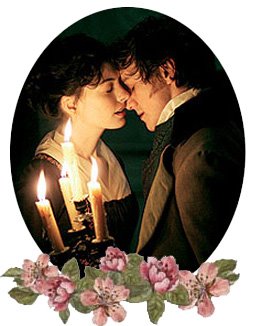
Pic: Screen shot from the 'Last Reading' scene of 'Becoming Jane'


Sunday, 6 July 2008

Jane Austen’s admirer from Ireland

Thanks to Mariana, I can upload this article albeit taking too long a time. And no, the title does not refer to Thomas Langlois Lefroy. Not directly, at least! Below is the summary of what Mariana informed us a few weeks ago.

It’s about one of Jane’s letters written on 25 September 1813 from Godmersham Park (Wednesday, Nov. 3), in which she has a very interesting comment regarding S & S and the fact that she is “read & admired in Ireland too”. The letter is quoted below:

Cassandra 1813: Godmersham Park Wednesday Novr* 3d*.

“Who has it next?-I am glad William's going is voluntary, & on no worse grounds. An inclination for the Country is a venial fault.-He has more of Cowper than of Johnson in him, fonder of Tame Hares & Blank verse than of the full tide of human Existence at Charing Cross.-Oh! I have more of such sweet flattery from Miss Sharp!-She is an excellent kind friend. I am read & admired in Ireland too.-There is a Mrs. Fletcher, the wife of a Judge, an old Lady & very good & very clever, who is all curiosity to know about me-what I am like & so forth-. I am not known to her by name however. This comes through Mrs. Carrick, not through Mrs. Gore-You are quite out there.-I do not despair of having my picture in the Exhibition at last-all white & red, with my Head on one Side;-or perhaps I may marry young Mr. D'arblay.-I suppose in the meantime I shall owe dear Henry a great deal of Money for Printing & c.-I hope Mrs. Fletcher will indulge herself with S & S.” (Mariana’s emphasise)

We all know that Jane wanted to remain anonymous (Lord Brabourne edition): “There is also an interesting entry of the date of September 28, 1811: "Letter from At. Cass. to beg we would not mention that Aunt Jane wrote Sense and Sensibility."

Godmersham Park-Sept: 25. 1813: “People shall pay for their knowledge if I can make them. Henry heard P. & p. warmly praised in Scotland, by Lady Robt* Kerr & another Lady; & what does he do in the warmth of his Brotherly vanity & Love, but immediately tell them who wrote it! A Thing once set going in that way-one knows how it spreads!-and he, dear Creature, has set it going so much more than once. I know it is all done from affection & partiality but at the same time, let me here again express to you & Mary my sense of the superior kindness which you have shewn on the occasion, in doing what I wished. I am trying to harden myself. After all, what a trifle it is in all its Bearings, to the really important points of one's existence even in this World!”

The Irish admirer “happened” to be the wife of a judge and not any judge, but the one connected with Tom Lefroy. Even more interesting is the fact that Mrs. Fletcher was “all curiosity to know about me-what I am like & so forth. I am not known to her by name however.”

Memoir of Chief Justice Lefroy - Chapter III

On the resignation of Judge Mayne, in 1820, he was offered the vacant seat in the Queen's Bench, by Earl Talbot, but he declined the offer. Again in the following year, on the resignation of Baron George, he was offered the vacant seat on the Exchequer Bench, by the Marquis of Wellesley, who had then succeeded Earl Talbot in the Lord Lieutenancy of Ireland; and in 1823, on the death of Judge Fletcher, he was offered a seat in the Court of Common Pleas, also by Marquis of “Wellesley”.

To learn more about Judge Fletcher, read the old article of Connaught Journal of Galway, Ireland (Monday, June 9, 1823) here.

Both names, Gore and Carrick could be linked to Lefroy, although it might be a simple coincidence. Mariana could not find any other information about these two ladies other than a small review of Mrs Carrick for Mansfield Park in Pemberley.com: "All who think deeply & feel much will give the Preference to Mansfield Park."

Anyway, bottom line is that a Mrs. Fletcher, wife of Judge Fletcher, knew about Jane Austen’s book, and she was keen to know more about Jane. As Judge Fletcher was within Tom Lefroy’s circle, could it be that Tom Lefroy himself recommended the book to Mrs. Fletcher?

Or are Mariana and I reading too much between the lines?

Pic: Thomas Langlois Lefroy by G. Engleheart from the Independent UK


Saturday, 5 July 2008

Jane Austen Quote - Week 11 by Linda

I love this one from Emma! Emma is informing Mr. Knightley that Harriet Smith had refused an offer of marriage from Robert Martin. Mr. Knightley says:

"Then she is a greater simpleton than I ever believed her. What is the foolish girl about?"

Emma then comes back with this gem:

"Oh! to be sure," cried Emma, "it is always incomprehensible to a man that a woman should ever refuse an offer of marriage. A man always imagines a woman to be ready for anybody who asks her."

I simply have a hard time believing Mr. Knightley’s response:

"Nonsense! a man does not imagine any such thing”…

- Chapter 8, Emma


In my heart I think Jane got it exactly right. Well, I could be wrong, but not wishing to offend our gentlemen readers, I will say no more. They may defend themselves as best they can. Of course, there is always the exception that proves the rule, too.

Linda the Librarian

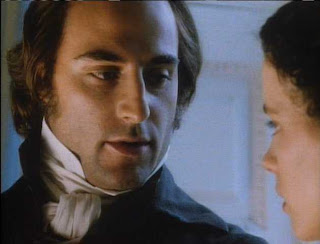
Pic: Mark Strong as Mr Knightley from: Strange Girl

Tuesday, 1 July 2008

Persuasion Audiobook Read by Olivia Williams

Sadly, I don't like audiobooks, but if I did, I would buy this one! I have heard raving comments about Olivia Williams' (Jane Austen, Miss Austen Regrets, Jane Fairfax, Emma 1996) reading of Persuasion. It clocks in at 7 hours, 45 minutes, and is available to download from Silk Sound Books.

Being seen to be left on the shelf at the advanced and spinsterish age of twenty-seven was something Jane Austen knew about only too well. In Persuasion she uses the dry yet merry voice of Anne Eliot, the heroine and one of the most popular female characters in English literature, to tell this story about the ridiculous sport of trying to find a decent husband.

Jane Austen wrote the novel when she was forty and actually thoroughly happy with her position on the shelf, and her confidently funny take on life as an unmarried woman and the daftness of the level of worry that a girl has to go through before eventually finding the ideal match shines through this glorious book.

Olivia Williams’ calmly witty reading for silksoundbooks of Anne’s expedition through the beautiful but vicious salons of eighteenth century British society is a wicked joy. This is Austen at her best; funny, warm, sharp and ultimately powerful in her description of how to survive the persuasions of those around us who think they know what it is to be successful.

Pic: Amanda Root and Ciarán Hinds from Persuasion 1995 from: Quizilla

Friday, 27 June 2008

Jane Austen Quote of the Week- Week Ten

My choice for this week is taken from Pride and Prejudice. I adore this part of the novel where Elizabeth rejects the marriage proposal of her cousin, Mr Collins. I think it is such a well-constructed part of the story and absolutely hilarious. I love the strength and utter defiance of Lizzy. Mrs Bennet responds to this rejection of marriage by visiting Mr Bennet and demanding that he talk to Lizzy and tell her to accept the proposal. She delivers these words:

"Not that I have much pleasure, indeed, in talking to anybody. People who suffer as I do from nervous complaints can have no great inclination for talking. Nobody can tell what I suffer! But it is always so. Those who do not complain are never pitied."

- Mrs Bennet, Chapter 20, Pride and Prejudice


Whenever anyone has asked me which character I find the most comical throughout all of Jane's novels, I always say Mrs Bennet. No one but her has such an impact with her words. Its Jane's craftsmanship that is so commendable. Particularly the line 'Those who do not complain are never pitied' is so wise and meaningul but yet is produced in such a humorous light considering her character throughout the novel.

Pic: Jane Austens World

Saturday, 21 June 2008

Jane Austen Quote - Week Nine


This week my quote is from Fanny Price, in Mansfield Park. There are so many amazingly quotable quotes from MP that I'm planning on using one next time, too. :)

Mansfield Park, Penguin Red Classics 2006, volume II, page 216.

"If any one faculty of our nature may be called more wonderful than the rest, I do think it is memory. There seems something more speakingly incomprehensible in the powers, the failures, the inequalities of memory, than in any other of our intelligences. The memory is sometimes so retentive, so serviceable, so obedient; at others, so bewildered and so weak; and at others again, so tyrannic, so beyond control! We are, to be sure, a miracle every way; but our powers of recollecting and of forgetting do seem peculiarly past finding out."

Oh yes! I just love this quote - it gives me a serious case of the "warm fuzzies". Memory can be both a blessing and a curse, but this time I'm going to dwell on the positive side since I'm currently having a Pollyanna-esque love-affair with my own memory ... Oh! Memory is a fickle thing. I love how pointedly Fanny expresses her deeper thoughts about memory (once again, Jane at her finest, understanding humanity/life) - "so retentive ... so obedient" and yet also "weak ... and beyond control" Oh brother, yes! I have just come out the other side of the examination room, and I can vouch for the hair-raisingness of my own somewhat "bewildered" memory, and yet at the very same time, I can nurse my favourite memory, which never dulls, and which makes me glow with happiness every time I recall the scene and face ... oh yes, I love my memory. It is a wonderful gift.

Pic: Frances O'Connor as Fanny Price from: JASA

Friday, 20 June 2008

The most expensive hair in the world!

Thanks to Mariana for the tips, we learn of the sale of a lock of Jane Austen’s hair. Experts were actually unsure if the lock was actually Jane’s, but it still did not fail to attract buyers. Dominic Winter Auctioneers of Gloucestershire eventually sold the lock for more than GBP 4,800. The lucky and rich buyer is Holybourne Rare Books on behalf of an anonymous Janeite. The auburn coloured lock was fashioned into a weeping willow encased in a three-inch frame.

There’s a discrepancy with the final price. The Telegraph UK said it was GPB 5,640; BBC and Wilts and Gloucestershire Standard said it was GBP 4,800. According to WGS, auctioneer Chris Albury said that “If we had been able to prove it conclusively I'm sure there would have been a lot more bidders and a much higher price.”

Oh my. How much could it be then? GBP 50,000, like Engleheart’s painting of Tom Lefroy? Good God, Willoughby

By the way, if any of you missed James McAvoy, you might want to read this article of The Telegraph. It’s about Wanted, not Becoming Jane, and James did not use his British/Scottish/Irish accent, but still it’s JMA!

Pic: The famous lock of Jane Austen, from BBC

Wednesday, 18 June 2008

My take on 'Miss Austen Regrets'

It’s a long delay, but I finally saw Miss Austen Regrets (MAR) a few nights ago, and now would like to offer you dear friends my review. First of all, I have to admit that this review will not be as balanced as I want to, because of my personal preference to Becoming Jane (which has mixed acceptance, I understand), so I apologise in advance if I offend anyone in the process. I started watching MAR with as open mind as possible. I wanted to like the movie; mostly because I don’t want my love to BJ prevents me from enjoying another interpretation of Jane Austen’s life. It’s unfair for me to do so, and it would block my attempt to understand those who disagree with my views.

I found out that I was in love with the colours, the scenes, the tones of the movie. I also love the fact that many Austen ‘supporting characters’ from Edward Austen to Reverend James Stanier Clarke appeared in the movie. JS Clarke by the way, was Prince Regent’s chaplain and librarian who drew a mysterious sketch of a sweet young woman, later to be confirmed as the Jane Austen herself. Hey, we also saw the timid Revd. Papillon whom Jane flirted with several times. And of course, the famous Mr. Harris Bigg-Wither, heir to Manydown Park, who proposed to Jane in the evening of 2 December 1802, and who also opened MAR with the same proposal to Jane. Adhering to the historical account, the movie proceeds with Jane and Cassandra Austen leaving Manydown Park. Then, the movie Jane wishes that she would never go back to that day and regret what she has done.

Talking about Jane Austen in MAR, I have to first talk about Olivia Williams. I admire her acting in MAR, more than I was amazed by her ‘tiny’ role as Jane Fairfax in Emma 1996. Ms. Williams showed me a very lively Jane Austen, a writer so full of life that so many a young and old men fell for her. I thank Ms. Williams for that. Other supporting characters, including Greta Stacchi (Mrs. Weston in Emma 1995) who played Cassandra Elizabeth Austen, were also admirable. No complains whatsoever acting-wise.

But then, enters Fanny Knight (later Knatchbull) and I was amazed at how this very niece of Jane Austen was used as the main supporting character (more than Cassandra Austen herself) who helped the tapestry of the movie. I understood from JA’s letters, and also from a friend here Arnie, that Fanny Knight was supposed to be JA’s favourite niece. But from JA’s later letters and my discussions with Arnie, I believe that JA’s favourite niece was actually Anna Austen Lefroy (married to Benjamin Lefroy, Tom Lefroy’s cousin). Anna was the only one in the Austen family that was not sceptical or bitter towards Jane’s past story with Tom Lefroy. Why, Anna married a Lefroy then, and her daughter (Anna Jemima Lefroy) later married Thomas Edward Preston Lefroy (son of Anthony Lefroy, Tom’s younger brother). Anna was a believer of love, and she understood Jane Austen completely. (On this note, Mariana found something on Jane’s later letter that might proof the importance of Anna Austen Lefroy in Jane’s life, even after so many years. I hope to find a decent time to post her findings.)

Okay. So MAR used Fanny Knight instead of Anna Lefroy (who, thank God, appeared in the movie to introduce baby Jemima to Jane Austen). I will go for that. But then appeared 4 to 5 men (I lost count already) in less than 2-hours movie, saying that they admired Jane Austen, but then nothing was to be done with those men. Some of them had wives already (e.g. Rev Brook Bridges), some just harmless flirtation… and one physician (Dr. Charles Thomas Haden) particularly flirted with Miss Austen long enough to make us believe that there would be something there (though wouldn’t last, because we knew JA never married).

True, there was nothing. For young and smart Dr. Haden (he was one of the first users of stethoscope, how cool was that?) then flirted with Fanny Knight and left Jane jealous and insecure with her spinster status.

And there lies one of my problems with this BBC drama. I am an avid believer of Jane Austen and Tom Lefroy, all of you know that. But I also acknowledge that Tom Lefroy and Mary Paul had a happy marriage. I used to have difficulties in accepting that; but not anymore. There is a difference between keeping a fond memory of old sparks and turned it into a more chaste admiration while at the same time having a good family life, and another one: keeps regretting what happened and not being sincere with your present life. I think Tom Lefroy finally chose the first option, and I respect him (and Jane Austen) for that.

With that note, and considering the many letters of Jane Austen that actually did indicate her inclinations towards several other men post-Tom Lefroy, I do believe that Jane did try (unconsciously, or to some degree consciously) to find another heart for her. To some extend she did, as proven by the letters. She also did not, as she remained unmarried. So what MAR tried to explain here has a grain of truth. Jane Austen did ‘have’ a considerable troop of lovers and admirers. But she remained single, and why? This ‘why’ was not properly explained by MAR. It’s okay, that’s not even a problem for me, for it’s very hard to know the true answer.

As I said, that is not my problem. My problem is that this production makes Jane Austen a bitter woman who constantly felt sorry for what she was, for what she believed in (i.e. not marrying without affection). No, she didn’t regret NOT marrying Bigg-Wither. She regretted that she could not provide a secure income for her sister and mother, and hence would leave them poor and destitute when she died. Perhaps her regret happened because at that time Henry Austen’s bank collapsed, Edward Austen faced a law case, and Jane herself was getting ill, with not enough money for medical attention &c. Okay, I might be able to accept that, based on the movie’s storyline.

But did Jane Austen truly regret? Guaranteed, at any points of our lives we do regret. Then we contemplate again and again, and arrived at the conclusion that – despite whatever that would happen – we did not regret taking that action. Because if we took another course, the consequence would be worse, or our pride or faith would have been compromised.

Alas, I don’t have my hardcopy of JA letters here to check her last letters. But if my memory serves me right, I did not detect any regrets in her last letters. She accepted her illness and imminent death with grace and courage I hope I will have when I face my own end. She fell asleep on Cassandra’s lap and left this world peacefully, like an innocent child. She did not regret her decisions in life, the way Tom Lefroy did not regret his.

And, Tom Lefroy aside, was that awareness present in the MAR? That Jane Austen was a woman of pride and faith, a strong woman that believes in herself, in her chosen path, no matter how bitter, rocky and thorny it was? True, granted, she would fell into despair now and then, only to be reminded again of her decisions and faith in herself, and she would definitely sprung up to life again, embracing her disappointments and sadness, to be a better person. NOT a bitter person.

That is not the Jane Austen I saw at the end of MAR. I saw a regretful and bitter Jane Austen who kept hurting herself with her despair. I don’t say that the movie should not show her downfall and sadness; nay, those made her more humane. But must the movie end Jane’s scene with her crying, wailing at the backyard for her demise? Can’t it end gracefully with her accepting all her contradictions and making peace with her past? That true, it hurt, but life must move on, and Jane herself moved on too?

I’m not saying that one of the major premises of the movie (i.e. the need of money to guarantee happiness – just look at Fanny’s marriage to Mr. Knatchbull) is 100% incorrect. But it should not be the major thing. I’m a fool if I say that I don’t need money to type this review (where would my laptop and internet connection come from?). But I’m also a fool if I believe that the latest model of Mac or iPod (or a great house with horses in Jane Austen’s world) will satisfy my happiness. To a certain degree, yes, I need money. Everyone does. But above that, we need our faith, love, and pride. We need to believe in what we do, in our chosen path, with all its flaws and blemishes. Based on those, we move on.

Many Austen fans were insulted by what Becoming Jane presented at the last scene; i.e. Jane Austen looked pensively yet lovingly at Tom Lefroy, and received the same look in return. It is an offence because a great writer like Jane Austen should not hold onto an old rugged fling like that. Whatever for; she did not receive anything in return, right? It’s as if nurturing an unconditional love equals to begging for attention or being a submissive and weak woman.

So, unconditional love is wrong. Yet, bitterness and constant regrets is acceptable?

I am a mid-30s single woman living in a patriarchal society who sees single women (and single mothers) as alien species from another universe. I look up to Jane Austen as one of the rare examples of classical women (i.e. born before the 20th century) who dared to challenge society’s established views and lived alone, unmarried. Two hundred years have passed, and still the social conditions in many places of the world remain the same for women. Respectable women are only those who married, or at least have spouse. Then and only then, they are secured and protected from society’s judgement that there is something utterly and incredibly wrong with them for choosing not to marry, or simply not yet married nor having partners. Then and only then they are protected from the constant sexual harassment (directly or veiled) launched at them for they are still single, and hence harassment is permitted. If it is still hard for me to live in such a world, then what kind of horrors Jane Austen faced daily back then? Spare me the gory details, I don’t want to know.

Now my dear friends, do you see why I am dismayed with this production? If I have to choose between: a) “being single and still maintaining unconditional love, no matter how unreturned it was” to b) “being single and bitter with man’s world and the world in general”, I will wholeheartedly choose the first option. True, it is personal. But is it not true that most of Jane Austen’s thematic issues were about personal relationships anyway?

Guaranteed, BJ has many historical inaccuracies; I admit that. Our findings here so far have confirmed that what happened between Jane and Tom was not truly as portrayed in BJ. But it did not change the fact that I still love BJ.

For all its flaws and blemishes, BJ still presents me with hope and faith for unconditional love, no matter unrequited it has been. That whatever disappointments Life present you, you can still move on to be a better person; not a bitter one. That is the choice we should make every day, every moment of our lives. On the other hand, MAR shows me bitterness and regret, something that I prefer to live without for the rest of my life.

Regretfully, I dislike Miss Austen Regrets.

Pic 1: Olivia Williams (Jane Austen) and Imogen Poots (Fanny Knight), from BBC Drama

Pic 2: Imogen Poots (Fanny Knight) from Miss Austen Regrets.com

Pic 3: Williams, Poots, and Greta Scacchi (Cassandra Austen) from Miss Austen Regrets.com

Tuesday, 17 June 2008

The Jane Austen Survey 2008

I thought I had already blogged about this survey, but it seems not!

"Have you read all six of Austen's major novels? Do you consider yourself a sincere admirer? If so, you are hereby invited to participate in this survey of Austen readers. It will take about 15 minutes to complete. Results will be presented at the annual meeting of the Jane Austen Society of North America (Chicago, October 2008)."

Read about the survey here, and here is the direct link to the JA 2008 survey. I did this it a while ago, and it was fascinating and FUN! (and much quicker than 15 minutes, for those time-pressed Austenites out there :) I strongly encourage everyone to take a few minutes and participate. Share your thoughts here! I can't wait for the results.


Pic: Fanny, by Cassandra from: JASURVEY

Sunday, 15 June 2008

Jane Austen Quote – Week Eight

Sorry for the late installment of this week’s JA Quote; Team Jane have been busy bees as of late. Anyway, I thought of this quote a few days ago, and am quite relieved to be able to write about it now.

“A woman especially, if she have the misfortune of knowing anything,
should conceal it as well as she can.”

(Northanger Abbey, Chapter 14)


Many Austen fans said that Jane Austen truly understood human nature, and I still have to yet again acknowledge that. Why…as I said, I thought of this quote a few days, and it was when I had to face several men who opposed my opinion on an environmental issue. Being an avid environmentalist, I spoke out what I believed in, and was hoping for a good discussion entailing that.

But perhaps, I was too outspoken, and what I got was just those men staring at me as if I was not allowed to make any comments. Or perhaps they did not agree, but they didn’t want to ‘stir the water’ by rebutting my argument. They did resume the discussion though, after I left, and I bet they were refuting my points freely when I was not around. Too bad; all I wanted was a good discussion on my points and how to come out with the best solution. Perhaps, in a patriarchal society as I was in that day, I had breached the traditional convention. Sigh.

Or perhaps, as Marianne Dashwood noted in Sense & Sensibility, “Had I talked only of the weather and the roads, and had I spoken only once in ten minutes, this reproach would have been spared.”

Sigh again. Thoughts?

Pic: Felicity Jones as Catherine Morland from PBS.org


Tuesday, 10 June 2008

Tom Lefroy on Sale!

Well, his miniature portrait, to be exact! Thanks to Anielka and Jane Odiwe for their scrutiny, I found about the sale of Tom Lefroy’s miniature picture drawn by George Engleheart in 1798, and it’s on sale for GBP 50,000 now!

The sale is conducted by Judy & Brian Harden at the Grosvenor House Art and Antiques Fair on June 12-18, 2008 at Stand 23. This is what their site says:

SHOWING AT THE GROSVENOR HOUSE ART AND ANTIQUES FAIR JUNE 12TH-18TH STAND 23.

We shall be offering for sale,an important piece of JANE AUSTEN'S history. A portrait miniature of her young lover Tom Lefroy by George Engleheart. The original, signed, painting, of which only one other version was made.

What are you waiting for? Any of you rich Jane/Tom fans can start bidding now. Obviously not me, though I’m a hard core fan. My cash now is not even enough to buy the frame, haha!

The first picture up there is the miniature portrait to be sold by the Hardens. Take a look at the picture. It’s rather different from the one we usually have on the left here, no? It’s because Engleheart only made TWO of these portraits, and the one we have on the site is the one currently held by the Lefroys in UK/Ireland. The one on sale is the second version, with rather firmer facial structures, but no less handsome.


But I have to tell you, there is a third picture here that makes me confused, is this one also the portrait currently held by the Lefroys? It was available in Maggie Lane’s Jane Austen’s World. This picture should have been the one held by the Lefroys, but somewhat still differs slightly. Perhaps the lighting.

There is also a very lovely article of Tom Lefroy’s portrait sale at The Independent UK. Here’s the excerpt of what The Independent wrote about the sale and Brian Harden’s comment about the portrait:

The watercolour, which is painted on ivory and measures just 3 inches by 1 ¼ inches, is on display at the Grosvenor House Art and Antiques Fair, at Park Lane in London, from Thursday. It is by Engleheart, the great English miniaturist, and the only one which is dated and signed with the artist's distinctive cursive E. The other portrait remains in the hands of Lefroy's descendants.

Brian Harden, one half of the Gloucestershire-based specialist dealers Judy and Brian Harden, who are selling the painting, said: "We bought this at auction quite a long time ago and it's been in our private collection since that time. We didn't know whom Tom Lefroy was when we bought it – it went through the auction house unrecognised – but we were able to identify and discover the history of the sitter. It's a very fine piece. The sitter is very handsome and personable. It was painted just two years after he met Jane Austen."

Sigh… Two years after he met Jane Austen…swoon…

Anyone up to the bidding, just let us know. Meanwhile, we will keep monitoring the sale and report back to you for the final result.

Pic 1. Thomas Langlois Lefroy by George Engleheart, from The Independent UK

Pic 2. The other version of Tom Lefroy’s miniature portrait kept by the Lefroy descendents (picture courtesy of Edward Lefroy)

Pic 3. Tom Lefroy’s portrait from Maggie Lane’s ‘Jane Austen’s World’. It should be the same with the one kept by the Lefroys.


Friday, 6 June 2008

JA Quote Week Seven by Linda

The following quote is special for its very personal meaning to me.

Elinor agreed to it all, for she did not think he deserved the compliment of rational opposition.

(Sense and Sensibility, Bantam Books 1983, Chapter 36, page 218)

Have you ever known someone who was so convinced that every word they uttered was absolutely correct with no room for error? I have. I only wish I had had the above quote at hand to remind me of the correct attitude to take towards such a person.

After reading that quote, it brought to mind a saying that my 10th grade English teacher put up on our blackboard as a “Thought for Today” feature that she blessed us with. It said: “Some people’s minds are like concrete, thoroughly mixed up and firmly set.”

Hopefully, you do not know such a person, but if you should, please be kind and keep this quote in mind.

Once again, this proves how ‘up-to-date’, ‘with it’, or whatever you call it, that our dear Jane was, and most especially, how people have not changed in all the intervening years, or before her time, for that matter.

Linda the Librarian

Pic: Emma Thomson's Elinor Dashwood from Jane Austen Info

Tuesday, 3 June 2008

Winner of the BJF Anniversary Quiz!


Sorry for one day delay for the quiz announcement, I had a network problem yesterday. Anyway, after two weeks of announcement, finally we arrive at the winner of the BJF Anniversary Quiz! Team Jane would like to express our sincere gratitude to all readers and friends who have submitted their answers. It’s very surprising to have friends from Canada, the US, Belgium, and even Kazakhstan and Malaysia visiting us; a proof that Becoming Jane is indeed a popular and touching movie.

Anyway, without further ado, these are the answers for the quiz:

1. What was Jane Austen’s last letter that directly referred to Tom Lefroy?

Answer: Letter 17 November 1798, where Jane talked about Mrs. Anne Lefroy’s visit and that Mrs. Lefroy’s nephew was to go to Ireland to be a barrister.

“Mrs. Lefroy did come last Wednesday, and the Harwoods came likewise, but very considerately paid their visit before Mrs. Lefroy's arrival, with whom, in spite of interruptions both from my father and James, I was enough alone to hear all that was interesting, which you will easily credit when I tell you that of her nephew she said nothing at all, and of her friend very little. She did not once mention the name of the former to me, and I was too proud to make any inquiries; but on my father's afterwards asking where he was, I learnt that he was gone back to London in his way to Ireland, where he is called to the Bar and means to practise.”

Choose two places of BJ movie locations that have association with Tom Lefroy

Answer:

b. King's Inn, Dublin: Located on Henrietta Street, this is where the court-related scenes of BJ were conducted. The young Tom Lefroy (McAvoy) was late that time, and he had to run upstairs to the court room, and he passed a wall of stained glass. Interestingly, the name of the real Thomas Langlois Lefroy (“Thomas Lefroy, Esq.”) was there in one of the glass panel (our dear Rachel saw it when she went to Dublin and took the picture), for Tom Lefroy was indeed one of the best graduates of the law college (“On the window were the Coat’s of Arms of all the relevant people in the history of Irish law. Of course the Chief Justice, our Tom, was presented, in the bottom right hand corner.”).


e. Bray, Co. Wicklow: Some of the Becoming Jane scenes (Lady Gresham's manor) where done outside the Kilruddery House in Bray. Interestingly, Bray was the coastal town where the real Tom Lefroy passed away on 4 May 1869.

And the winner is: Mariana Gheorge!

Congratulations to Mariana! We will send the BJ DVD to you soon!

Oh, and a friend (Gail) asked how she could join a BJ fan club. Well, unfortunately, Becoming Jane Fansite is not an official fan club of the Becoming Jane. However, it IS a fan club in many ways, and we don’t have any memberships. Just drop by often to discuss stuffs about BJ and Jane/Tom, and you’re already part of the family!

Pic 1. One of the earlier movie poster of Becoming Jane

Pic 2. The stained glass in King Inn’s College, Dublin (photo by Rachel Kingston)

Pic 3. Kilruddery House in Bray, County Wicklow (photo by Rachel Kingston)

Sunday, 1 June 2008

Jane Austen Quote of the Week- Week Seven


The other quotes so far have been from Jane's novels but I thought that I would remind everyone of a brilliant quote from one of Jane's letters to her beloved sister Cassandra. All of my contributions so far to this weekly feature have been very short quotes; I think that one of the wonderful attributes of Jane was how she could say so much with only a few words. Her strength of character and enormous bravery and independence as a woman is really demonstrated.

Anyway my quote, taken from her letter written on 24 December 1798:


"I do not want people to be agreeable, as it saves me the trouble of liking them."

I love these words and never bore of hearing them; they make me laugh every time. I really respect her character and wit.


I would love to hear any comments......


Pic: JA's watercolour painting done by Cassandra, c1810