Showing posts with label Costumes. Show all posts

Monday, 19 March 2012

Austen film Memorabilia For Sale!


The Jane Austen Centre newsletter has made us aware of an exclusive auction now on ebay of original costumes from some of Jane Austen's film adaptations. They were chosen to host the eBay auction for the celebrated BAFTA and EMMY award winning costume designer, Andrea Galer.


The auction began a few days ago and ends next Sunday 25th March. Worldwide postage is available!


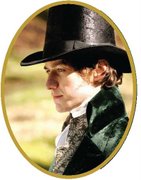
Included are costumes from Persuasion and Miss Austen Regrets, plus two 'Mr Darcy' (Matthew MacFadyen) waistcoats.


View the auction here


Pic: from the ebay auction

Wednesday, 1 December 2010

Crack myself on a Jane Austen dress!


Forgive my indulgence Ladies and Gents... but I have a story to tell. I know this humble Jane Austen fan who could not help herself when she saw a beautiful 1960s empire dress that resembled a Regency dress being sold on an online shop called Etsy (weird shopping habits, these creatures of the 21st CE!). She must have it, although not at any cost (what with being a student), and after much deliberation (which lasted only a few minutes actually), she bought it!

In her defense, she had been searching for a decent Austen dress which would not make her ample bosoms look larger and would still fit her rather uhm... healthy frame. Several talented dress makers in Ebay (that is another online site, weird 21st CE citizens, very accessible through the famous Google Avenue!) have tempted her in the past, only to have her deterred by the excessive price (of over $100!). In recollection, it is only fair that we must forgive this rather reckless young lady, for indeed she had done her homework of researching better prices in the past, to no avail of course. Also we must consider her plan to visit a certain dear Miss Kingston in Surrey en route visiting Chawton and Bath, and what dress more proper to wear than this (old but) new blue 60s dress?


Do forgive her, Ladies and Gents... for she promises that she would publish the weekly quote in time this week (after one dear Mrs Fern supplies her one). And she solemnly promises not to be so impulsive in purchasing any other Regency artifacts next time, lest she would not have the means to visit the aforementioned Miss Kingston!

Wednesday, 25 July 2007

Dressing Jane: About the Costumes

This time, I copy an article from the U.S. about the costume. I’m happy to see that quite a few of my earlier observations in the female and male costumes were correct (including Tom's white coat referring to Jane's letters on January 9 and 16, 1796). But of course, this article gives more info than what I have excavated. See the U.S. Official Site, under the ‘About the movie’ and ‘Production Notes’ for ‘Dressing Jane’. I've said it, and I will say it again: this movie deserves an Oscar for costume design!

As with the photography and production design, Julian Jarrold hoped to take a different view of Austen-era costumes in BECOMING JANE. For this, he worked with Emmy-nominated Irish costume designer Eimer Ní Mhaoldomhnaigh ("David Copperfield," THE WIND THAT SHAKES THE BARLEY).

"Like most people I studied Jane Austen at school so I was familiar with her world," says Ní Mhaoldomhnaigh. "But I deliberately moved away from recent film adaptations of Jane Austen's work and my priority was to try to do something different. 1790s Regency England was a very transitional era in terms of fashion so it was a real challenge to make it work."

Ní Mhaoldomhnaigh read up on the fashion of the day, visited museums for inspiration, consulted Austen's letters for clues and reread the novels for context and color. In particular she investigated the influence of continental fashions and also the likely differences not only between town (London) and country (Hampshire) but between the social classes. She discovered that Jane and her family were quite fashion conscious - but the family's financial circumstances dictated that they make their own clothes. While practical clothes were required for the farm yards, there was also the opportunity to dress up and show off at the occasional local ball.

By the mid-1790s, Ní Mhaoldomhnaigh also learned, fashion was becoming simpler, moving away from the huge dresses of the French Revolution and towards a more modern look. "Things were heading towards the Empire line which is a very basic style influenced by the Roman and Greek civilizations," she says. "1795 marked the beginning of that trend. But because Jane Austen was from the country which is slower to adapt to fashion changes we are showing just the introduction of that. The look in London of course is very different from the look in the countryside."

Ní Mhaoldomhnaigh sourced authentic fabric in India and scoured the costume houses of London as well as the BBC costume department. "We kept away from very ornate fabrics and were very careful to pare back the look," she says. When it came to dressing Jane, Ní Mhaoldomhnaigh made Anne Hathaway's wardrobe entirely from scratch, using a combination of research and intuition. "I wanted to get her youthfulness and innocence across through her dress," she states. "But crucially there was also her strength of character. So we kept away from frills and flounces. I wanted a look that was quite strong but also pretty. Jane was living on a working farm so her dress had to be practical as well. We were definitely trying to steer away from the chocolate box image that we associate with Jane Austen." Ní Mhaoldomhnaigh sifted through Austen's own correspondence to get a better picture of the writer's fashion sense and sensibility. "In her letters to Cassandra, Jane talks about going into town and buying new ribbon for her hat," she says. "She would not, at that time, have been able to afford a new hat so she buys ribbons and flowers to trim the bonnet. People would also visit from London and Jane and her friends would ask them about the latest fashion in London. She would write in her letters of new fabric that she had bought and she would describe it in detail."

It didn't hurt that Ní Mhaoldomhnaigh was dressing the preternaturally lovely Anne Hathaway, who became a close collaborator in the creation of her character's costumes. "It was great to dress Annie," the designer says. "She had just come from THE DEVIL WEARS PRADA, in which she wore all this amazing couture fashion and now I had to talk to her about wearing simple cotton dresses! But she was very keen to get the details right. Sometimes I would suggest a little extra piece of lace but she would say that it might be too much. She really grasped what we were trying to do. Of course Annie looks so wonderful on camera that she doesn't need adornment."

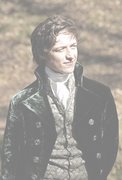
Meanwhile, Ní Mhaoldomhnaigh focused equally on creating clothes for Tom Lefroy that reveal him as a fashionable man-about-town. The designer was partly inspired by Jane Austen's letter to Cassandra, in which she writes of Lefroy: "He has but one fault, which time will, I trust, entirely remove - it is that his morning coat is a great deal too light. He is a very great admirer of Tom Jones, and therefore wears the same colored clothes."

But she also was influenced by the screenplay's colorful portrait. "When we first meet him, Tom is boxing, boozing and cavorting so there's definitely had to be rakishness to him," says Ní Mhaoldomhnaigh. To make Lefroy stand out from the crowd, Ní Mhaoldhomnaigh used a few tricks of the rag trade. "We used much richer fabrics like velvets," she says. "For his hat we used a beaver fur which is a lot more luxurious than the other hats. He wears very stylish waist coats and cut-away jackets.

With Jane around he'd have an extra swagger in front of her. James was really into it. We'd talk about the colors and fabrics to achieve his distinctive look." Ní Mhaoldhomnaigh notes that men's fashion at the time was also in a state of flux in 1795. "Some of the younger men have cut away style jackets which were just coming into fashion," says Ní Mhaoldomhnaigh. "In the countryside the men were wearing slighter older fashions except for those who had been to London and picked up styles there like a silk waist coat which they would wear to the ball.

Long trousers did not come into vogue until the early part of the 1800s. Men wore riding boots which were practical but also fashionable. Men's calves were seen as very sexy at the time so if somebody had good calves it was something to be proud of."

Of the other characters, one of the most distinctive is Maggie Smith's Lady Gresham. "I spoke with Maggie and told her that I'd like her costume to be from a slightly earlier period," recalls Ní Mhaoldhomnaigh. "We went for the 1770s, the sort of dress that the Of the other characters, one of the most distinctive is Maggie Smith's Lady Gresham. "I spoke with Maggie and told her that I'd like her costume to be from a slightly earlier period," recalls Ní Mhaoldhomnaigh. "We went for the 1770s, the sort of dress that the character would have worn when she was much younger. Lady Gresham is very much her own character and is not someone who is dictated to by fashion. She looked quite stern, almost gothic so the colors that we choose were greys and sea greens. Everything about her is quite rigid from the skirts to the fabrics. She wears a very large hood called a calash that was very common at the time. No one else in the film is wearing it so it makes her look quite different and even eccentric. Maggie loved it.

Not so enjoyable were the corsets -- de rigueur in Regency England but the bane of the 21st Century actors' lives. "Having to put on the corsets, especially first thing in the morning, they would say, ‘Oh do I have to?’" recalls Ní Mhaoldomhnaigh. "But that's how you get the distinctive look and silhouette of the period."

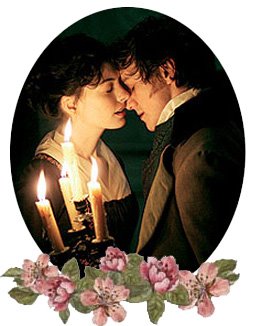
Pic 1,2 and 5: www.annie-hathaway.com

Pic 3 and 4: www.james-mcavoy.net

Saturday, 23 June 2007

Costumes of 'Becoming Jane' in Chawton House

Rachel has found these beautiful pictures of costumes worn by characters in Becoming Jane, currently displayed in Jane Austen's House Museum in Chawton. We lost the link, apologize for that, but will acknowledge the sources once we found it. Or, if possible, I would be glad to have the owner of the images to email us (Icha and Rachel), as finding the link was rather hard (we've tried to locate it several times). Again, sorry for our mistake.


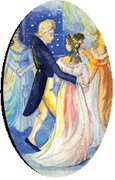
Anyway, the costumes above were worn by Tom Lefroy (James McAvoy) and Jane Austen (Anne Hathaway), respectively, during the ball in Lady Gresham's manor. I particularly love Jane's Regency pale green dress and Tom's deep green velvet coat; the costumes matched their chemistry. Simple, but lovely.

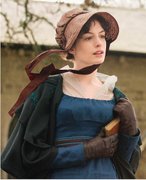
This blue dress is the Regency costume Jane usually wore for house work. I love the blue fabric and the grey sash; it helped bring out a sense of simplicity in Jane (while her red dresses promoted her wittiness!).


This one is a lovely white cotton Regency dress Jane also wore, but I could not remember any scenes where she wore it. I don't think it was the white dress she wore beneath the red Belle-ish cricket dress.


The above is a very lovely red Rococo/Georgian dress worn by Eliza (Lucy Cohu) as she arrived in London. She was extra gorgeous in it.


This is the Rococo/Georgian dress Eliza wore during her wedding with Henry Austen. A nice one, but I was rather expecting her to wear the silver Rococo dress she had during the ball in Lady Gresham's manor. Now that was what I call a wedding dress for Paris; but maybe too extravagant for Hampshire. I hope we can find a nice pic of Henry's red uniform in Chawton later.


This gorgeous purple dress was worn by Lady Gresham (Maggie Smith) during the dinner when Cassandra found out that Thomas Fowle had died in India. I have to say Lady Gresham looked truly menacing in this dress, in a good way! Pair her with Judi Dench, and no couples will escape them! Jane/Tom and Elizabeth/Darcy had to fight for their lives!


Tom Lefroy donned this brown overcoat during his elopement with Jane Austen. The overcoat has a historical value, for it was the very coat Jane held dear with her life as she read the faithful letter from Tom's mother. Poor girl, she must have missed the coat so much, for I bet Tom's scent was everywhere on the coat. Sob-sob!


Pictures of costumes with the characters: www.annie-hathaway.com, except for Tom & Jane dancing (www.james-mcavoy.net) and the wedding of Eliza & Henry (Jane Austen's Regency World Magazine March/April 2007)


Friday, 1 June 2007

Costumes of Becoming Jane – male characters

When Tom Lefroy met Jane Austen for the first time in 1795/96, Regency clothing had begun to seep into the daily life of Englishmen. Laces and decorative embroideries that had been essential in the early and mid 18th century were abandoned, replaced with more sensible and carefully-tailored plain clothes. Breeches (an early incarnation of short trousers covering the body from the waist down, usually followed with silk white stockings) were out of fashion and being replaced with real trousers or pantaloons. Essential parts of men fashion in the late 18th century now included: linen shirt (without pleated frills at the cuffs and front opening), high-waisted waistcoat (vest), trousers, and cravat (a long clothe, usually white, tied around the neck several times; the predecessor of modern ties) and a coat with long tail and tall standing collar. Men in the late 18th century also often wore overcoats or greatcoats, such as the ones Joe Anderson (Henry Austen) often donned in Becoming Jane. The gentlemen also wore high boots (usually Hessian boots) and tall hats and carried batons.


In the movie, James played a very fashionable Tom Lefroy. However, he once wore a white coat in the first ball (Basingstoke Assembly) in the movie, though white coat was not a fashion (see Pride and Prejudice Oxford edition 2004, explanatory note #6 p. 313, referring to p. 6 where Charles Bingley wore a blue coat on his first visit to Longbourn). On January 16, 1796, Jane Austen wrote to Cassandra about Lefroy’s wearing a white coat and how she had disliked it (‘I rather expect to receive an offer from my friend in the course of the evening. I shall refuse him, however, unless he promises to give away his white coat.’ – Jane Austen’s Letters, Chapman 1979). The fact that light-coloured coats were not fashionable during Jane Austen’s time might trigger Ms. Mhaoldomhnaigh’s witty idea to put James in a light-coloured coat for the first ball. He did not wear a very white coat though, as seen up here (James and Anne talking to Julian Jarrold), but it still counted as light-coloured, and definitely not blue, which was a fashionable colour at that time. I will try to get a better picture of James in the white/cream coat.

James always wore cravat – except when boxing – and he looked sooo good in cravats! Well... he looked good bare-chested as well, actually... Ahem. James often wore a tall hat and carried his baton (e.g. to Selbourne Wood and London). James also wore dark trousers, which looks better for him than the light one (both Colin Firth and Matthew Macfayden occasionally wore light trousers during their roles as Fitzwilliam Darcy in Pride & Prejudice 1995/2005, but I still prefer it when they wore the dark trousers).

As Tom Lefroy, James had many dark velvet coats to wear; dark blue (during his first visit to Jane’s house), dark brown (in London), black (during the walk in the woods) and dark green (during the ball in Lady Gresham’s manor). Apparently, Basingstoke Assembly was the only time he wore light coat, possibly to receive a comment on Jane afterwards (referring to JA’s letter on January 16).


James also wore an ochre-coloured vest during the assembly and when he played cricket with Henry and Jane, but I am sure that Jane did not mind his ochre vest. He looked dashing there! During their elopement, James’s Tom Lefroy sported a very nice greyish or brown double-breasted overcoat that Jane would later hold on so dearly after she read the letter from Tom’s mother (See the article re: female costume to see James' grey overcoat). Do you remember that particular scene when Tom asked Jane if she was alright? I do… and I still feel broken-hearted. Sobs…sobs… Nooooo!!!


Ahem. Anyway. Joe Anderson was a handsome Henry Austen, and as an Oxford militia officer, he got to wear a beautiful scarlet uniform! Remember what Eliza (Lucy Cohu) said: ‘Scarlet looks good in you’? It was indeed! See the picture here on their wedding day. Also, here’s a picture of Joe/Henry with a brown overcoat that suited him very well.


The edited version of this article has been posted in Wikipedia.

Pictures:

Tom Lefroy in frame, Eliza & Henry: Jane Austen's Regency World March/April 2007
The rest: www.annie-hathaway.com

Reference:

Austen, J. 1813, Pride and Prejudice (2004 edition), Oxford University Press, Oxford.

Chapman, R. W. 1979, Jane Austen's Letters to Her Sister Cassandra and Others, 2nd edn, Oxford University Press, Oxford.

Monday, 28 May 2007

Costumes of Becoming Jane – female characters

Costumes worn by characters in this movie are a mixture of the late Baroque/Rococo (also called Georgian) and Regency styles. Ms. Eimer Ni Mhaoldomhnaigh has done a great job at creating gorgeous costumes for Anne Hathaway (Jane Austen) and Lucy Cohu (Eliza de Feullide), and of course fans of James McAvoy would notice how he looked dashing (not that he’s not handsome, duh!) in his Tom Lefroy velvet coat and white cravat (cravat is a very good idea for James!). In this section, we are going to discuss costumes for female characters first. Tom would have to wait later.

The year 1795 was a special year for regency dress, for high empire line began to be a new fashion, and tight corsets were abandoned (yay! The whales were happy!). With the line placed below the breasts, Empire/Regency dresses tried to imitate Greco-Roman styles adorning sculptures and arts of female Greek goddesses and nymphs. Look at Wikipedia for more detailed explanations of the Regency fashion from 1795-1820. It was actually called ‘Directoire’ from 1795-1799, but it did not look so different, so here I just simplified it as ‘Regency’ or 'Empire' dress.

Austen’s first surviving letters to Cassandra was dated 9 January 1796, and it was a day after Tom Lefroy’s birthday (interestingly, James McAvoy was also born in January, 1st January, I guess). We don’t know if Tom had stayed during the Christmas as well or not… but during the first week of 1796 (or since the last weeks of 1795), he had met Jane… and, according to the movie, the girl was very fashionable, for she adopted the new fashion of high-waist line!


But, although 1795 was the beginning of the Regency fashion, many women still wore Rococo/Georgian-style dresses. In the movie, Eliza de Feullide was one of them, and my oh my… we cannot argue that Lucy Cohu looked elegant in her outer jacket and neat hat. Oh, by the way, Anne often wore a hat, or bonnet, to be precise, with ribbons (JA loved ribbons!) and occasionally shawl, for the relatively thin Empire dress materials were not sufficient for the climate of England/Ireland (and so it had been in the late 18th century, when the popularity of shawls increased to accommodate the thin muslins).

In the movie, Anna Maxwell Martin (playing Cassandra Austen) wore Rococo/Georgian dresses. In the OST cover, I just saw the pink Rococo-ish dress she wore during her walk on the beach with Anne after the latter arrived from London. I also remembered Cassandra's lovely pale blue ribbon during the sombre dinner in Lady Gresham’s manor where Cass heard that her fiancée (Thomas Fowle) had died in San Domingo, the Caribbean. I can still recall her sorrow…

Anyway, back to the costumes. Of course, the real treat of Regency dress in Becoming Jane is, naturally, Anne Hathaway’s costumes. Let’s see… she wore the lovely thick cotton-ish blue and red dresses, the floral dress she wore in the library (and for the Basingstoke Assembly) and the Belle-like red and white dress (during the cricket play or when she refused Wisley’s proposal… poor guy…) for daily work. She also had this lovely chocolate embroidered dress she wore on her elopement with Tom.

But the haut couture was the pale-green dress (silk-organza perhaps) Jane/Anne wore while dancing with her Mr. Lefroy in the second ball. Ah! I cannot forget their eyes... nor the lovely dress. And the pearl earrings! My God. Where can I get those earrings?! Anne's hair was tucked in Grecian style, by the way, an easy but lovely hairdo, with a lovely pearl-adorned headdress.


Anne also wore a lovely empire-line red coat during her visit in
London and her elopement. Lovely coat for sad events… sobs! I think she wore a straw bonnet with red ribbons for both occasions.


I also recall that Jane was the only woman who constantly wore the empire line dresses, with the exception of the red Belle-like dress. I guess, it served to make Jane (Anne) the centre of attention, not that she really needed that…

As I said earlier, Rococo/Georgian dresses were worn by the rest of female characters. Lucy Lefroy also wore a cream Rococo dress whenever she wanted to charm Tom (didn’t she get it? Tom was a dashing, fashion-up-dated, Londoner. Of course Jane’s chance of capturing his heart was better with new lines of Regency dresses! LOL!). But the feast of Rococo dress was again in Eliza’s. I was particularly interested in her silver white ball gown she wore with Henry Austen. Her wedding dress and the red dress in London were handsome as well. I will try to get the picture later.

Jane Austen House in Chawton currently displays several costumes worn by characters in Becoming Jane, including Jane Austen's pale green ball gown and blue daily dress, Tom Lefroy’s dark green velvet coat (for the second ball), LadyGresham’s purple and black ball gown and Eliza de Feullide’s gorgeous red dress. Anybody got the pictures, send me and I will forever thank you!

For further reading, see History of Western Fashion in Wikipedia, notably the late Baroque/Rococo era (1750-1795) and Regency era (1795-1820). I have posted the edited version of this article in Wikipedia, with the help of Rachel, of course!


Pictures: www.annie-hathaway.com, except for Jane & Tom dancing (www.james-mcavoy.net)