Showing posts with label Family and friends. Show all posts

Monday, 18 November 2013

Jane Austen Quote of the Week 252

I am using James Austen's "The Loiterer" for my Jane quote since I sincerely believe that Jane was influenced by his writings and she learned a lot, too. Since I have a minor in History, you will know that I love that subject and that is why I quote from James Austen's periodical "The Loiterer" Issue No. 7 this week. I will only quote a few sentences in order to pique your interest to read the entire Issue. So, speaking on the subject of "history" James writes in the second paragraph:
 

It relates indeed the vices of tyrants, the meanness of their flatterers, and the miseries of their people; but it relates also the virtues of their destroyers, the public spirit of a party struggling for liberty, and the happiness of a nation which enjoys it. And if the unhardened sensibility of youth, and the unpolluted bosom of innocence, will turn in disgust from the short-lived frenzies of a Caligula or a Claudius, they will dwell with repeated rapture on the glorious annals of a Trajan or an Antonine. - Since history can boast examples at once so powerful to deter from vicious extravagance, and incite to virtuous undertakings, no wonder it has been ever the favourite study of the wise and great: that it has stimulated the one to new discoveries, and the other to difficult achievements.
Well, I make no claim to be one of the "wise and great" due to my study of history, but I have certainly learned a lot from it. I remember the old saying that "history repeats itself" and I can see history repeating itself in these present days of turmoil and troubles as well as seeing those who "turn in disgust" from these turmoils.
I highly recommend the entire issue for your consideration and you may read it here: The Loiterer, Issue No. 7.
Because of my intense love of History and due to the events of these days, I stumbled onto a slew of historical writings that shed a lot of light on the current events of today. Consequently, I found Daniel Defoe, William Wilberforce, and the multitude of "periodicals" mentioned by my esteemed and beloved James Austen in his Loiterer. I have found tons on line and have downloaded many so that I can have them on hand, especially since they are out of print. Thank goodness for Google books. And lest I forget, the multitude of writings mentioned by Jane, herself. I must say that all that will keep me busy for quite a while and they are too numerous to mention all the titles. So Happy Reading and Searching.
Linda the Librarian
 

Monday, 5 November 2012

Jane Austen Quote of the Week 211

Here I go again! Off on another tangent! Here's the story. My dear Mother-in-law has been telling me about the benefits of drinking a glass of wine for many years, especially since she has done so for about 70 years herself. So I finally got around to trying a bottle lately and I did feel a difference. So what has that got to do with our dear Jane Austen, you may well ask. I went on a search through her brother James' Loiterer and found the following from Issue No. 14:


The Loiterer No. XIV

THOUGH I know not in what degree of estimation, you have been accustomed to hold the science of Alchymy, yet as the author of every useful invention has a claim on the attention of the candid and liberal, I have made choice of your paper, as the vehicle, to impart to my countrymen a discovery, which has for its object the health and happiness of some thousands of his Majesty's subjects.

You must know, sir, it was ever my opinion that there did exist such an universal panacea, as should not only cure all diseases indecent to the human body, and prolong life to its utmost period, but should be equally beneficial to our mental, as to our corporeal powers; should make us not only healthy, strong, and bold, but also learned, sagacious, and witty. In pursuance of this idea, I have devoted many years to the discovery of this valuable secret; have persevered in my search, in spite of the contempt of the prejudiced, and the laughter of the gay; and now think the attention of my past life well rewarded, in being enabled to impart to my friends a secret, which will promote the happiness of theirs, and which (unlike the generality of modern projectors) I shall generously communicate to the public, without any subscription whatever.


Know then, sir, and tell your readers, that this inestimable medicine, so long sought in vain, that its existence is almost become doubtful, is neither more nor less than port wine— which, I will venture to say, if taken in proper quantities, will answer every purpose of an universal medicine, and be found a most perfect restorative in all diseases both of body and mind.

------

Please pardon the long quote, namely the first 3 paragraphs, because it addresses the question about the benefits of a glass of port wine. My only problem is trying to decide whether or not James includes a bit of satire or whether he is very serious about it. I did a search of Jane's novels and Lo and Behold! she includes quite a bit of wine drinking!

You may read the rest of the issue HERE and make a determination for yourself.

Now - the bottom line is this: how many other things/foods are out there that we are not aware of that may possibly be beneficial to us? I will give you just one example in my own life, well, maybe two.

I am in the middle of reading "Alzheimer's disease, what if there was a cure?: the story of ketones" by Mary T. Newport. She is recommending the use of coconut oil (so far as I have read yet) and she gives quite a medical/scientific explanation - which is hard for this limited scientific mind to grasp. So this morning I made some quinoa and added some coconut oil. I will get back to you on the results in a month or so.

As a matter of fact it is only in the last year or so that I have discovered other things such as quinoa and tulsi tea from my friends who come from other countries. Thanks, Icha, for the tea recommendation, it works! As I said, how many other things do we need to know about? Please feel free to make recommendations.

Yrs aff'ly,

Linda the Librarian   Pic: Port bottle

Wednesday, 22 August 2012

Jane's Ring ... SOLD

The turquoise and gold ring that belonged to romantic novelist Jane Austen 

Sorry it has taken us a while to write this information but a ring belonging to Jane Austen sold for £152,450 at a Sotheby's auction in London on July 10th, this was over five times the predicted price!

An article from the guardian newspaper states "The turquoise and gold ring came to Sotheby's from Austen's family, complete with a note sent by Jane's sister-in-law, Eleanor Austen, in November 1863, to Jane's niece, Caroline Austen. "My dear Caroline," wrote Eleanor. "The enclosed ring once belonged to your Aunt Jane. It was given to me by your Aunt Cassandra as soon as she knew that I was engaged to your uncle. I bequeath it to you. God bless you!""

The ring was passed from Jane Austen to sister Cassandra Austen to sister-in-law Eleanor Austen to niece Caroline Mary Craven Austen to niece Mary A. Austen-Leigh to her niece, Mary Dorothy Austen-Leigh, then to her sister, Winifred Jenkyns, who passed it to her descendants.

There has been speculation that the ring was given to her by Tom Lefroy but experts predict that she actually received it from her brother Henry who she was very close to.

Pic: http://www.guardian.co.uk/books/2012/jul/06/jane-austen-ring-for-auction

Sunday, 1 July 2012

Jane Austen Quote of the Week 197

I have spent this past week on vacation at my childhood home with my dear Sister and I managed to do some genealogy searching of our past history/lives.  I had a restful and profitable week for which I am grateful.  Now, what has that to do with our dear Jane Austen.  I promptly went to her brother's periodical "The Loiterer" (which I put on line) and found Issue No. 7 which discusses the "use and advantages of Studying History".  Here is an excerpt from the first paragraph:

IF the respective merits of our different studies are to be settled by the pleasure which arises from their pursuit, or the utility which results from their attainment, historic knowledge will justly claim the highest rank amongst our literary acquirement. To review with one glance the various accidents, and mark the latent causes, which have given birth to states, or destroyed empires, to place before us the exploits of the daring, the discoveries of the adventurous, and the systems of the wise, confers the greatest superiority which an enlightened age and a polished nation can enjoy, over an area of darkness and a clan of barbarians. And though history were always what it too often is, only an enumeration of the madness, folly, and crimes of mankind, it is yet some advantage to know what we would wish to avoid; and if mankind make a proper use of this knowledge, they may derive some benefit even from the crimes, and some wisdom from the follies of their ancestors. But history has surely something better to offer, has other claims upon our attention, other motives to excite our industry, and other sweets to reward our labours. 

I find that I cannot disagree with James because I found out so many of our family's "dirty" little secrets as well as the "good" things that we did.  I managed to do some research at our court house through many papers that documented our comings and goings.  My Bachelor of Science degree includes a minor in History, so you can see that I am in my element when I do my historical research.  I really wish to return more often to do some more.  May you all benefit from studying "History"!  Because some of it we do not want to repeat!!

You may read the entire article - No. VII of James Austen's  The Loiterer.

Yrs aff'ly,
Linda the Librarian

Picture:  http://www.betterworldbooks.com/the-loiterer-1792-id-1166249247.aspx


Monday, 14 February 2011

And some love for Jane's brother George...


I have been meaning to post this one, but I kept forgetting it. Last January, Jane Austen Centre of UK adopted one of our old articles about George Austen (Jane's brother, not her father), the deaf in the family. Laura of the JA Centre expanded it by adding a lovely letter from Jane that depicted her ability to use sign language. The letter is below, and the link to George in JA Centre is here.

"We spent Friday evening with our friends at the boarding-house, and our curiosity was gratified by the sight of their fellow-inmates, Mrs. Drew and Miss Hook, Mr. Wynne and Mr. Fitzhugh; the latter is brother to Mrs. Lance, and very much the gentleman. He has lived in that house more than twenty years, and, poor man! is so totally deaf that they say he could not hear a cannon, were it fired close to him; having no cannon at hand to make the experiment, I took it for granted, and talked to him a little with my fingers, which was funny enough. I recommended him to read Corinna." ~Jane Austen to Cassandra, December 27, 1808


Thanks so much Laura for thinking of George too. He is usually rather forgotten, and it's nice to give love to someone like that.

Pic: Jane (Anne Hathaway) and George (Philip Culhane) from Becoming Jane the movie

Friday, 17 December 2010

Eliza de Feuillide at Jane Austen Centre UK!

Our deep gratitude once more to Laura Boyle of the Jane Austen Centre UK for using one of Becoming Jane Fansite articles in their prestigious website. This time, Eliza de Feuillide nee Hancock is the Christmas feature of the year. JA Centre has taken this article, excellently written by Rachel in July 2007 (dear Lord, that long ago?!).

Once again, thanks to Laura for the adaptation and Rachel for the article!

Pic: Eliza (Lucy Cohu) and Henry (Joe Anderson) in 'Becoming Jane' (2007)

Saturday, 20 September 2008

BJ Fansite's article of Madam Lefroy at the Jane Austen Center!


My deep gratitude to Laura Boyle and her Jane Austen Center in Bath, and also to dearest Rachel who wrote an excellent biography of Madam Anne Lefroy last year, we now have the Madam Lefroy article from Becoming Jane Fansite attached and quoted by the Jane Austen Center. Here's the link to the Madam Lefroy section at the Jane Austen Center.


It's a pleasure for us to help you, Laura. Ladies, keep up the good work! I understand we've been pretty quite because of our schedules, but we're still here to support the amicable friendship of Jane Austen and Tom Lefroy!


Pic: Madam Anne Lefroy from the Jane Austen Center

Wednesday, 24 October 2007

Short biography of Reverend George Austen

Hello All.

Due to the busyness of our everyday lives, we have not made a post for a while. We have not gone anywhere though and are still very dedicated to Jane and Tom and their story.

Kari has been busy though on her exciting travels to Amsterdam. We will report of her adventure shortly. Now though, I thought it was important to continue with information about Jane and what was very central to her life; her family. This short article is about her father.


The Austen background is somewhat interesting. A very enterprising young woman called Elizabeth Weller (George Austen’s grandmother) married wealthy John Austen in 1695 and started their family which led to seven children in nine years. In 1704 John Austen died young, leaving his wife with the seven young children and numerous debts. The family of John Austen did not honour their promises to help financially but Elizabeth was determined to educate her children (six were sons). She worked as a housekeeper in a schoolhouse in Sevenoaks and her payment was her son’s education. They consequently all gained solid education’s to enter the world of work and she also managed to organize a strong marriage for her daughter so Elizabeth could settle knowing that she had done her best for her children.


Elizabeth’s son William (George’s father, Jane’s grandfather) became a surgeon and married Rebecca Walter in 1727 in Kent. They had four children; the first girl died young, the second girl was named Philadelphia, the first son was George (Jane’s father) and the third girl named Leonora. Rebecca died giving birth to Leonora and William died shortly after in 1738. The children were now orphans so were separated and sent to live with various family members. George, now 7 (born in 1731) went to live with his father’s only sister, Aunt Elizabeth, and her husband in Tonbridge.


George attended the Tunbridge School and later studied at St John’s College at the University of Oxford with a fellowship. He won a scholarship in 1751 to study divinity. By the age of 24 he was back in Tonbridge working as a teacher before he was invited to become assistant chaplain back in Oxford. Here he met Cassandra Leigh and three years later, married her in April 1764 in Bath. In the meantime he had been offered the livings of Deane and Steventon. George was given one living by his uncle Francis who paid for his education and another by his distant cousin, Thomas Knight of Godmersham (who would later adopt his son Edward).


The young married couple began at the Deane parsonage but later, after repair was complete, settled at Steventon rectory to begin their family. Over the next fourteen years they had six sons and two daughters. To financially support this large family, Reverend Austen opened a boarding school for the local boys belonging to the parish.


It is clear that George Austen promoted happiness within his family; there were regular sessions of family reading, games and music. He obviously recognized Jane’s potential when he sent a letter in November 1797 to the publishing firm Caddell and Davies with the view to making an arrangement to publish Pride and Prejudice. The letter was rejected but this act shows a faith in his daughter’s talent and potential as a female author.


It is assumed that George Austen was a handsome man. One account of his appearance was offered by Jane’s niece, Anna Lefroy, who wrote, “I have always understood that he was considered extremely handsome, and it was a beauty which stood by him all his life. At the time when I have the most perfect recollection of him he must have been hard upon seventy, but his hair in its milk-whiteness might have belonged to a much older man. It was very beautiful, with short curls about the ears. His eyes were not large, but of a peculiar and bright hazel. My aunt Jane's were something like them, but none of the children had precisely the same excepting my uncle Henry.”


After a very happy marriage of 41 years, George Austen died on January 1st 1805 in Bath. On January 2nd, Jane wrote to her brother Frank about their father. She wrote: "We have lost an excellent Father. An illness of only eight and forty hours carried him off yesterday morning between ten and eleven. His tenderness as a father, who can do justice to?"

I think that this gives a clear impression to us as to what type of father George Austen was to his eight children.


Pics
1. George Austen from the painting port website
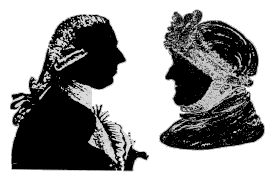
2. Silhouettes of George and Cassandra from the Pemberley Website
3. The immediate Austen family tree from The Jane Austen Society of Australia (which I hadnt spotted before but I love it!)
4. George Austen (played by James Cromwell) in Becoming Jane from Mirror newspaper article

Sunday, 19 August 2007

A tribute to George Austen, Jane’s forgotten brother

One of the many things that made me love Becoming Jane was the interactions between Jane Austen and her brothers in the movie. Granted, the movie only included Henry Austen and George Austen there, and left Jane’s other brothers in the conversations only. But it was very important to me that George Austen, of all people, was included. People who have read JA biographies would learn that George was a forgotten son in the Austen family due to his mental incapability. After reading more info about George, I was glad that Julian Jarrold &c decided to include George in the movie, paying homage to Jane’s abandoned brother. So, this is a short article and a tribute to George Austen.

George Austen (1766 – 17 January 1838) was actually the second son of Revd. George Austen and Cassandra Leigh. He was born with a mental handicap; hence he was kept away from the rest of the Austen family. It was one of the dark secrets of the Austens that David Nokes elaborated in his 1997 biography, Jane Austen: a Life. However, Claire Tomalin’s book (2000) of the same title recalled George in a slightly different light; George still received the luxury to become the godson of Mr. Hancock (Eliza De Feullide’s father).

Tomalin noted that George, who possibly suffered cerebral palsy, still lived in Steventon as a child. On November 8th, 1772, Mrs. Austen wrote to her relative Ms. Susannah Walter that she was at home with her four sons; that would mean that George was still in Steventon in 1772, with James, Edward and Henry. However, in 1779 a decision was made to trust George to a Culham family who lived in Monk Sherborne, about three miles from Basingstoke (Nokes’s version was Cullum, instead of Culham). George would later spend his entire seventy-two years there with his uncle, Mr. Thomas Leigh (brother of Jane’s mother Cassandra Leigh), who also suffered mental setback. Hence, based on Tomalin’s analysis, Brother George Austen was still in Steventon when Tom Lefroy met Jane Austen during the 1795 Christmas holiday, as portrayed in Becoming Jane.

George Austen was rarely mentioned in the Austen family letters, except for several occasions, e.g. in letter July 8th, 1770 where Mr. Austen wrote to Susannah Walter that ‘We have this comfort, he cannot be a bad or a wicked child’ (Tomalin 2000, p. 8). However, the Austens seldom visited George in Monk Sherborne. At best, James Austen paid Mr. Francis Cullum a routine visit to give the latter the Austens’ contribution for George’s expenses (Nokes 1997). I am not sure if there is any letter of Jane talking about his brother George (she talked of other George, i.e. her nephew in Letter #60 (24-25 October 1808)(Faye 1997), but Tomalin mentioned that Jane Austen knew deaf and dumb sign language, as observed in her letter from the year 1808 (she talked ‘with my fingers’), hence it is possible that Jane sometimes interacted with Brother George in real life; or at least wrote about him in the confiscated letters. At any rate, it is very likely that Jane disliked her family’s indifferent treatment of George, for she wrote to her niece Fanny Knight, ‘Pictures of perfection as you know make me sick & wicked’ (Letter#155, 23-25 March 1817), although the letter was talking about Fanny’s admirer James Wildman (Nokes 1997).

Not unlike the way Jane silently paid homage to his Irish friend Tom Lefroy in her novels, the English authoress also paid her tribute to her forgotten brother George. Nokes noticed that in Persuasion, the Musgroves had an ill-fated son named Richard (Volume I Chapter VI). ‘Poor Richard’ was a ‘troublesome’, ‘thick-headed’, ‘unfeeling’, ‘unprofitable’ and ‘hopeless’ son, hence ‘had been sent to sea, because he was stupid and unmanageable on shore; that he had been very little cared for at any time by his family, though quite as much as he deserved; seldom heard of, and scarcely at all regretted…’

To me, it is interesting that Richard was once a crew of Captain Wentworth’s ship, and it was Wentworth who encouraged Richard to write to his family. The interesting part for me is that Wentworth was the embodiment of Tom Lefroy, and Richard was Jane’s way of paying homage to his brother. And in Becoming Jane, George Austen was there when Tom Lefroy interacted with Jane Austen…

In 1827, Edward Knight (the third son of the Austens) gave his entire inheritance from his mother (£ 437) to George (Tomalin 2000). Much later on January 17th, 1838, George Austen died of dropsy. In contrast to the grave of his famous sister Jane, George’s grave remained an unmarked grave in the churchyard of All Saints Church, Monk Sherborne. His death certificate only had the note of ‘A Gentleman’, proposed by George Cullum, son of Francis Cullum, George Austen’s life-long caretaker (Nokes 1997).

In Becoming Jane, George Austen was played by Philip Culhane, a partially deaf Dublin actor, who taught Anne Hathaway a rudimentary sign language for the purpose of the movie (see celebritywonder.com). George Austen was even an important player in the movie. In Becoming Jane, he was obviously not mentally-handicapped, for he responded appropriately to what his sister Jane and his mother said to him. George also chased Henry when his younger brother played with his rather silly hat. George was present when Tom met Jane for the first time in Steventon. George was ‘listening’ to Jane’s story of Tom Lefroy’s boxing adventure in Laverton Fair when Jane found out that Lady Gresham was visiting her house. George was also the one whom Jane walked with after she accepted Mr. Wisley’s proposal. And when Jane was busy convincing George (and herself) that she would be happy with Wisley, George was the one who spotted Tom Lefroy standing a few feet behind them. With sign language, Brother George also innocently asked if Jane loved Tom, to which Jane negated furiously, only to immediately receive Tom’s hot kisses over her.

I understand that the inclusion of George Austen in Becoming Jane might be inaccurate, although it is very likely that George was still in Steventon in 1796/97. But I love that historical inaccuracy, for it gave the movie more depth of a brother-sister bond between George and Jane, something that the real Jane Austen could not enjoy during her lifetime. And perhaps, although the real Jane might stand up and say ‘Pardon me, that scene is not correct for what truly happened was this and that’, I am confident that she would also thank the filmmaker and wished that George indeed was so much involved in her life.


Reference:

Faye, D. L. 1997, Jane Austen's Letters, Oxford University Press, Oxford.

Nokes, D. 1997, Jane Austen: A Life, Fourth Estate, London.

Tomalin, C. 2000, Jane Austen: A Life, Penguin Books, London.


Pic 1: George Austen (Philip Culhane) and Jane Austen (Anne Hathaway) walking from the field, from annie-hathaway.com

Pic 2: Mrs. Cassandra Austen, from University of Pennsylvania website

Pic 3: Cover to Persuasion, Wordsworth Edition


Tuesday, 14 August 2007

Anna Austen Lefroy in Jane Austen Centre &c

To end a busy day, I would like to thank Laura Boyle of the Jane Austen Centre in Bath, U.K. for adopting my previous article about Anna Lefroy (nee Austen) in the Jane Austen Centre website, particularly in the Austen family biography. During our conversations, Laura also gave a point that I missed out, i.e. that it was possible that Jane Austen did not attend the wedding of Anna Austen, for some unknown reasons. The info was apparently available in Maggie Lane's Jane Austen's World that I, alas, do not have.

On a side note, once more information is available, Rachel is going to write an article about the upcoming Miss Austen Regrets, a BBC TV production. Ms. Olivia Williams (Jane Fairfax in A&E Emma 1997) will play Jane Austen. Check IMDB for more development of this news. It is also interesting to note that Miss Austen Regrets was the title of a New York Times article written by Claude Rawson on 14 September 1997 to analyse David Noke's Jane Austen: A Life.

This is information about Miss Austen Regrets from the BBC site:

Based on her life and letters, Miss Austen Regrets tells the story of Jane Austen's final years.

When asked by her young niece, Fanny, to help vet potential husbands, Jane finds herself re-examining her own romantic life.

As she approaches 40 years of age, Jane appears happily unmarried and, to her niece, she seems an expert on love. Protected by her wit, Jane presents a front as dazzling as many of her novels' young heroines, but events conspire to potentially expose Jane's principled theories on love and marriage as ill-judged.

A chance re-acquaintance with a former suitor sees Jane lose her composure, and, when she meets her brother's dashing young physician, her passions are ignited.

Then, when her family faces financial ruin, it becomes apparent that all could have been very different had Jane accepted a marriage proposal from a wealthy landowner...


Apparently, the production will focus more on Mr. Bigg-Wither than Tom Lefroy or even that mysterious man who died not long after Jane met him in a seashore resort. Well, we shall see. All in all, 2007 is a good year for Miss Austen.


Pic: Anna Austen Lefroy, from David Cecil's 'A Portrait of Jane Austen' (1978)


Saturday, 4 August 2007

Mr. Wisley vs Mr. Harris Bigg-Wither

Becoming Jane viewers might not like John Warren who wrote the Judge the nasty letter (in fact, Warren was a pretty much decent guy who drew a sketch of Tom Lefroy and gave it to Jane Austen – letter 9 January 1796), but some viewers develop a sense of sympathy towards poor (well, rich) Mr. Wisley. I consent. I admit that I was not charmed by Laurence Fox’s Mr. Wisley during my first screenings, but then, upon watching the Husbands and Lovers scene again and again in YouTube, he somehow grew in me. Moreover, his last scene with Jane after he ditched his aunt Lady Gresham was touchy. Jane Austen and Mr. Wisley finally understood each other; they parted as friends.

But mind you dear friends, there was no Mr. Wisley in the real Austenian landscape (nor Lady Gresham for that matter). This sensitive guy was created purposely for Becoming Jane, to be Tom Lefroy’s rival. Laurence Fox did his job well; Mr. Wisley was indeed awkward in comparison to James McAvoy’s Tom Lefroy. And when I flipped through David Nokes’ Jane Austen: a Life (1997), I was struck by another ‘awkward’ friend of Jane Austen, a real person this time. He was Harris Bigg-Wither (1781-1833), heir of Manydown Park of Hampshire.

In page 251, Nokes describes Harris as ‘tall, clumsy and awkward, he would shamble through the house, or lounge on a sofa, adding little to the general conversation.’ Caroline Austen even said that Harris was ‘very plain in person – awkward & even uncouth in manner – nothing but his size to recommend him – he was a fine big man – but one need not look about for secret reasons to account for a young lady’s not loving him.’ (Nokes, 1997, p. 258).

Well… that was Mr. Wisley to me. And the fact that in the movie Jane Austen finally accepted Mr. Wisley’s proposal for a very short time (if not hours) before she met Tom Lefroy again in the forest makes me think that perhaps Mr. Wisley’s character was inspired a bit by Harris Bigg-Wither.

Now, to Harris. As I said, he was the heir of Manydown Park, a great house in Hampshire. Jane and Cassandra befriended Harris’ sisters and often stayed in Manydown Park for several weeks. The Bigg sisters (Elizabeth, Alethea and Catherine) did not use the ‘Wither’ name that was derived from their cousin’s name who, from whom they inherited Manydown. Harris was their little brother, six years younger than Jane. Manydown Park, by the way, was the place where Jane danced with Tom Lefroy in the evening of January 8, 1796.

In 1801, the Austens moved to Bath. However, Jane occasionally returned to Hampshire and stayed with, among others, the Bigg sisters. Such was the occasion in December 1802, where Cassandra and Jane stayed for a while in Manydown. At that time, Harris had returned from Worchester College, Oxford; a big tall guy now with golden future. In the evening of December 2, 1802, Jane found herself in the library (or a drawing room?), alone with Harris. It is very likely that the Bigg sisters and Cassandra might have orchestrated the private meeting. There, Harris proposed Jane… and Jane accepted. A happy night for everyone.

Except for Jane. She went to bed, but might not sleep after all. It was in Manydown in January 1796 that she danced with Tom Lefroy in such a ‘profligate’ manner. And now, almost seven years later, she accepted a proposal in the same house. But not from Tom.

We will never know Jane’s train of thought that night, it is possible that she talked with Cassandra about it. In any case, the very first thing she did the next morning was finding Harris and, again in private, cancelled their engagement. Afterwards, Jane and Cassandra simply could not stay longer in Manydown. The Bigg sisters ordered the carriage to take the Austen girls back to Steventon, where Jane later asked her brother James to take her home to Bath immediately. Confused, James finally cancelled his Sunday service to take his sisters back to Bath. And that was the end of Jane’s last marriage proposal.

Apparently, Harris dealt with his broken heart well. On November 2, 1804, less than two years after the faithful rejection, Harris Bigg-Wither married Anne Howe Frith from the Isle of Wight who gave him ten children. They lived happily in Wymering Manor, Portsmouth, Hampshire, and the friendship between the Austen sisters and the Bigg sisters were preserved.

I admire Jane Austen for her decision. She could easily succumb to the grandeur of Manydown Park, to the relatively easy life she could enjoy as the mistress of Manydown. She would be able to help her sister and her family then, and also taste a life of marriage she could only write about in her novels. But she did not do that. She cancelled the engagement, only 12 hours after her consent, risking her reputation and her friendship. She stayed true to her heart and principles, to never marry without love. And with that, she gave us six brilliant novels and three unfinished works that still show us the great woman behind the manuscripts.

Reference:

Nokes, D. 1997, Jane Austen: A Life, Fourth Estate, London.

Tomalin, C. 2000, Jane Austen: A Life, Penguin Books, London.

Pic 1: Jane Austen (Anne Hathaway) and Mr. Wisley (Laurence Fox), from BBC UK

Pic 2: Harris Bigg-Wither, from the Manydown site

Pic 3: Manydown Park, from Jane Austen Society of Australia


Saturday, 28 July 2007

Madam Anne Lefroy

Anne Lefroy, known as Madam Lefroy, was born in 1749 to the Brydges family at Wootton Court, near Canterbury.

When George Austen was made rector at Deane by his Uncle Francis, Francis also sold his assets in Ashe to a wealthy man, Benjamin Langlois, so that ten years later in 1783, he could also reward his own nephew, the Reverand Isaac Peter George Lefroy, by giving him the living of Ashe. The very attractive and cultivated Anne married the Reverand in 1778 and they lived as Ashe, making them the Austen’s closest neighbours. They had four surviving children; the eldest Lucy and three sons; John Henry George (who succeeded his father at Ashe), Christopher Edward and Benjamin Langlois (who later married James Austen’s daughter Jane).


Anne was a keen poet and her brother, Egerton Brydges, thought highly enough of her work to get two of her poems published before her marriage. In The Poetical Register and Repository of Fugitive Poetry, there are two poems by a Miss Brydges (Spence, 2003). The poems are considered witty and contain issues suited to the feminine mind such as masculine pretension. They show that she was at ease with herself and her feelings.


Anne and Jane, despite their age difference, formed a friendship that was marked by intelligence and respect. This friendship started when the Lefroy’s invited the 11 year old Jane to play with their 7 year old daughter. Due to a mutual love of literature, Anne and Jane began long literary discussions about novels, poetry and plays. It is believed that Jane shared her writing with Anne who acted as her friend and mentor. She was given free reign of their library at the Ashe parsonage. This must have acted as a important source of self-affirmation for Jane who was a child that was of limited confidence and needed encouragement and support in her early years.


Anne was a woman of charm, intelligence and means and soon became hostess to the neighbourhood. She opened a school for the poor children of the surrounding neighbourhood and taught them to read; this shows her determination and strong will, character traits that Jane would have greatly admired. She also personally vaccinated hundreds of people in her husband’s parish against smallpox (Ray, 2006). The Lefroy’s had a carriage and Anne would often lend out the carriage to families without, such as the Austen’s. These acts of kindness led her to be named ‘Madam’ Lefroy by all who knew her.


Anne was the aunt of Tom Lefroy who came to visit them in December 1795 after recently graduating from Trinity College in Dublin. It is unclear as to the role she played or her opinion of the loving relationship forming between Tom and Jane. She did organise a ball the Friday evening (15th January 1796) before Tom was to return to London but we are unsure as to what happened at Ashe on this evening. Jane did not receive any proposal, perhaps as she was expecting, or even some kind of assurance of a continued attachment between the two lovers. It has been speculated that Madam Lefroy became aware of the relationship that was forming between her nephew and Jane and promptly packed him off back to London before any more harm could be done. If this was the situation that it can be questioned why she encouraged the friendship between them and organised this ball before he left.


Perhaps out of some kind of guilt or duty to Jane, Madam Lefroy remained very interested in her matrimonial prospects. In the winter 1797 a Reverand Samuel Blackall was invited to stay at Ashe and became acquainted with Jane. Even after he had left, letters support that Anne Lefroy reported of events at Steventon, particularly mentioning Jane. His response ‘It would give me particular pleasure to have the opportunity of improving my acquaintance with that family- with a hope of creating to myself a nearer interest. But at present I cannot indulge any expectation of it.’ Nothing was to develop between Jane and the Reverand and she heard no more about him. Although she was probably not upset over his later indifference, it is sure to have dented her pride as it would any woman’s.


Anne died prematurely in a riding accident on December 16th 1804, Jane’s 29th birthday, when she was just 55 years old. The few months following Anne’s tragic accident must have been a very difficult time for Jane as her father died a month later on January 21st 1805. Jane was mid-way through writing The Watsons which she terminated and this only serves to represent the devastation she was experiencing.


Four years later Jane wrote a poem entitled ‘To the Memory of Mrs Lefroy’ which begins with the acknowledgment that her friend died on her own birthday. She expresses her feelings towards, and opinions of ‘Madam’ Anne Lefroy’s character. Here is a poignant extract:

“I see her here with all her smiles benign
Her voice of eager love, her accents sweet;
That voice and countenance almost devine;
Expression, harmony , alike complete.


Listen: ‘tis not sound alone- ‘tis sense,
’Tis genius, taste and tenderness of soul:
‘Tis genuine warmth of heart without pretence,
And purity of mind that crowns the whole.”


The whole piece can be found at http://home.earthlink.net/~lfdean/austen/poetry/lefroy.html
Although Anne Lefroy was clearly a dedicated wife and mother, it is clear that she was a very interesting lady who had a sense of independence in her mind and spirit.


References:

http://www.ashevillage.co.uk/helenlefroy.html

Spence, J. 2003, Becoming Jane Austen, 2007, Second edn, Continuum International Publishing Group, London

Shields, C. 2001. Jane Austen. Published by Weidenfeld and Nicolson.

Collins, I. 1998. Jane Austen. A Parson's Daughter. Published by The Hambledon Press

Ray, J.K. 2006. Jane Austen for Dummies. Published by Wiley Publishing Inc.


Pic 1: Madam Lefroy. Taken from www.austenblog.com/.../03/Madame%20Lefroy.jpg
Pic 2: Ashe Rectory. Drawn by E. Hill, 1901. Taken from www.jasa.net.au/japeople/img/ashe.gif

Update 20 September 2008:

The Jane Austen Center in Bath has adopted this excellent article for their Austen family/friends biography. Thanks a lot Laura Boyle of the JA Center and also to Rachel for the great bio! Here's the link.

Monday, 16 July 2007

Biography of Ann Radcliffe

In the film Becoming Jane, Jane Austen visits Cork Street in London (see Cork Street post; Cork Street, London ) and stays with Tom Lefroy and his uncle, Benjamin Langlois. During the short visit, Tom takes Jane to see Ann Radcliffe, the famous author of that time who ‘redefined the gothic novel as a metaphor for the female experience’ (Smith, 2003). Researchers have suggested that Radcliffe examined gender and the differences between male and female by focusing on the problems of dependence and isolation in women and how this may lead to problems of anxiety in a world dominated by men. Although Jane’s visit in the film is fictional, it is known that Jane highly respected, admired and was influenced by the work of Ann Radcliffe so we thought it important that she be acknowledged here.
Jane read Ann’s novels and even famously wrote a parody of The Mysteries of Udolpho in Northanger Abbey (1818). Catherine Morland reads Ann’s novel voraciously and this scares her and leads her to suspect a murder that has not taken place.


Ann Ward was born on July 9th 1764, in Holborn, London. She was the only child of William Ward, a haberdasher, and his wife Ann Oates. Little is known about her childhood except that she was well educated and spent most of her time with other family members and not her parents. When she was 24 she married the Oxford law graduate and editor for the English Chronicle, William Radcliffe.

Although it was considered a happy marriage, they did not have any children so Ann decided to start writing fictional novels; this was highly discouraged at that time due to her gender and the perception that she should not upstage the career of her husband. Disregarding this criticism, Ann had The Castles of Athlin and Dunbayne published in 1789. This was the start of a collection of novels focusing on mysterious castles which often played a pivotal role and was central to a very dark premise. Her writing consistently includes ghosts and spiritual voices and this allows the female heroines to test themselves and their inner strength in order to gain independence. She also frequently used landscape as a way of allowing the reader to identify and understand the characters and also to encourage the poignant themes of a society oppressing women. I think that it is a very interesting fact that the publishing records for her novel, The Romance of the Forest (1791), actually list her husband, William Radcliffe, as the author and he received £40 for the second edition.


Her writing was very popular, particularly among young women and her collection includes: A Sicilian Romance (1790), The Mysteries of Udolpho (1794) and The Italian (1796). Her last novel, Gaston de Blondeville (1826), was published after her death. She became the leading name in the genre of gothic romance and respected by many other famous writers, e.g. Mary Shelley, Charles Dickens. Her work was printed in Italian, German, French and Spanish and she became wealthy and highly recognised.
In addition to her talent as a writer of novels, she was also a poet and often included poetry in her novels. She had a poem published in 1826, again after her death, called St. Albans Abbey.


She was, however, somewhat of a social recluse. She would avoid social occasions and is famous for having never visited many of the places that she wrote about. For example three of her novels were based in Italy and she had never actually been there herself. Many historians have speculated that she may have suffered from mental illnesses such as depression or anxiety or both. According to her Memoir, ‘the very thought of appearing in person as the author of her romances shocked the delicacy of her mind’. The filmmakers of Becoming Jane presented this likelihood very well- when Jane Austen visits her home, there is a sense of social unease and discomfort. She stopped writing in her 30’s and this caused rumours at the time that she was insane or had in fact died. It is bizarre that she never corrected these allegations and instead remained very private in the comfort of her own home. Her life was such a mystery that a biography was abandoned by Christina Rossetti due to a lack of material.


It is interesting to think of the influence that Ann Radcliffe’s work has had on today’s culture; her themes have inspired plays and operas, and the genres of psychology and horror which are so frequently translated into literature and film.
On February 7th 1823, at the age of 58, she caught pneumonia (she had suffered from asthma for twelve years) and died. She was buried in a vault in the Chapel of Ease belonging to St. George’s, Hanover Square, in Bayswater, London.


Arnie provided the very interesting information that he read in The Recess by Sophia Lee that Ann Radcliffe may have been a parlour boarder at Sophia Lee’s boarding school in Bath and this means that there is the possibility that at that time she may have met Jane Austen. This is by no means proven but it does give validity to the film’s speculation that Jane met Ann at some point in her life, whether it was in London or Bath.
Jane was once described by one of her brothers as ‘enamoured of the picturesque’ which further supports why she would have been a fan of the work of Ann Radcliffe and have been influenced more than perhaps we realise?


Pic 1: Ann Radcliffe, taken from http://www.wikipedia.org/ No source specified.

Pic 2: Title page to The Mysteries of Udolpho, the novel which inspired Jane to include it in Northanger Abbey. Taken from Jane Austen The Parson’s Daughter, by Irene Collins. Published in 1998.

Pic 3: Photo illustration to represent the work of Ann Radcliffe. Taken from The University of Maine website, at http://umainetoday.umaine.edu/issues/v3i5/gothic.html

Friday, 13 July 2007

Biography of Cassandra Austen


Cassandra Elizabeth Austen was born January 9th 1773 in Steventon, Hampshire to Reverend George Austen and Cassandra nee Leigh. She was the fifth child of eight and the Austen’s first daughter. Her sister Jane was born almost three years later and being the only girls amongst six brothers, Cassandra and Jane remained exceptionally close throughout their whole lives.
This is evident from the numerous letters that have survived addressed to Cassandra from Jane during their limited time spent apart from each other.

When Cassandra was ten and Jane just seven, they were sent to a family member, Mrs Cawley, in Oxford who was going to educate them. She moved to Southampton and took the girls with her. An epidemic of ‘putrid fever’ forced the girls back to Steventon to their family. Two years later the sisters were again sent away but this time to Reading Ladies boarding school to be educated.

During the early years when Jane started writing her Juvenilia, Cassandra would begin what was to be a very supportive, stable role to her most beloved sister. Cassandra has repeatedly been described in biographies of Jane as caring, gentle, selfless and a woman of ‘extraordinary emotional control’ (Spence). She even aided Jane’s The History of England by providing the illustrations of the famous monarchs. Cassandra is known for her talent in art. She is famous for producing two paintings of Jane. In 1804, she depicted a back view of Jane sat by a tree. The second, and most famous, was created around 1810 and is a frontal portrait which now can be seen at the National Portrait Gallery in London.


Cassandra fell in love with Thomas Fowle in 1794 when she was 21 years old and they became engaged. Thomas became a chaplain with the military and was sent to the Caribbean on a mission to earn an income to be able to marry Cassandra. Utterly devastating Cassandra, Thomas Fowle died in 1797 in San Domingo in the West Indies from yellow fever. She inherited a sum of £1000 (around £50 a year) from his death but she never married.


From the rectory in Steventon, the Austen’s moved to Bath in 1800. When, in 1805, George Austen died; Cassandra, Jane and their mother moved to Southampton for a period of five years to be near their naval brothers Francis and Charles, before finally settling in Chawton, Hampshire in 1809. This dwelling suited them as it was near to Steventon where they grew up and felt most comfortable. Throughout their lives Cassandra and Jane always shared a bedroom and were rarely separated except when either of them was sent away to tend to the wives and newborn babies of their brothers. When they were apart they wrote daily but unfortunately Cassandra destroyed many of the letters; this remains one of the greatest mysteries. Was there something to hide that she did not wish to reveal?


I think a quote that summarises the relationship between Jane and Cassandra can be found in the Memoir of Jane Austen. The extract is from Anna Lefroy's letter to James Edward Austen Leigh (JEAL), p. 160.
"Their affection for each other was extreme; it passed the common love of sisters; and it had been so from childhood. My Grandmother talking to me once [of] by gone times, & of that particular time when my Aunts were placed at the Reading Abbey School, said that Jane was too young to make her going to school at all necessary, but it was her own doing; she would go with Cassandra; 'if Cassandra's head had been going to be cut off Jane would have her's cut off too' - "

Jane died in 1817 in Winchester with her head placed in Cassandra’s lap. Writing to her niece Fanny, Cassandra said: “I have lost a treasure, such a Sister, such a friend as never can be surpassed, - She was the sun of my life….I had not a thought concealed from her, and it is as if I had lost a part of myself” (Letter, July 20th 1817).

After Jane’s death, Cassandra made it her duty to ensure that the last of her sister’s works made print; she organised the two remaining novels, Persuasion and Northanger Abbey, to be published. Cassandra lived the rest of her days alone in Chawton Cottage until her death on 22nd March 1845. She was 72 years old. She is buried at St Nicolas church in Chawton with her mother (who died in 1827).

There is much negativity directed towards Cassandra. This is either due to the unattractive painting of Jane which people have argued was inaccurate (supported by Jane’s niece Anna) and created out of jealousy, or the way she criticised Jane for being less sensible than herself. What must be remembered, however, is that Jane clearly adored her sister and that the letters which do remain gives us insight into the mind of Jane Austen- this is only made possible by Cassandra who was, of course, the recipient but also perhaps the most important person in Jane’s life. She also made sure that their nieces and nephews learned about their aunt Jane. The respect that Jane felt for her sister is clear from another quote found in Austen-Leigh’s memoir of his aunt: “even in the maturity of her powers, and in the enjoyment of increasing success, she would still speak of Cassandra as of one wiser and better than herself.”

References

Austen-Leigh, J. E. (1871) A Memoir of Jane Austen and Other Family Recollections (2002 Oxford edition), Oxford World's Classics, Oxford.

Copeland, E., and McMaster, J. (1997) The Cambridge Companion to Jane Austen, University of Cambridge.

Ray, J. K. (2006) Jane Austen For Dummies, Wiley Publishing Inc, Indiana.

Spence, J. (2003) Becoming Jane Austen, Continuum International Publishing Group, London.


Pic 1: Silhouette of Cassandra Austen. Taken from The Jane Austen Society Website http://www.janeausten.co.uk/
Pic 2: The watercolour of Jane Austen painted by Cassandra.
Pic 3: A family picture: Mrs Austen, Eliza, Jane, Cassandra, Mr Austen and Thomas Fowle in Becoming Jane. Taken from
http://www.annie-hathaway.com/
Pic 4: Cassandra and Thomas Fowle in Becoming Jane. Taken from the Jane Austen Regency World Magazine
Pic 5 and Pic 6: Jane and Cassandra in Becoming Jane. Taken from
http://www.annie-hathaway.com/

Monday, 9 July 2007

‘Oh, what a Henry!’ Brief Bio of Henry Austen

Don’t be deceived by this picture of Henry Austen. Henry was definitely more cheerful than his expression here, particularly during his youth. He was charming and quite a good talker, that man. An attractive young lad and the fact that he was a member of Oxford militia (hence had the honour of wearing a scarlet uniform) did nothing to reduce his charms. Why, Jane even called his arrival ‘put life and wit into the party’ (Chapman 1949, p. 15).

Yes…Henry Austen was Jane’s favourite brother, the was Edward Austen was to Cassandra (Chapman 1949). In the Memoir of Jane Austen, Caroline Austen called Henry as Jane’s ‘especial pride and delight’. Indeed, she acknowledged his mischievousness, but in a loving way. In fact, ‘Oh, what a Henry!’ was her comment on him as she wrote to Cassandra on June 23, 1814 (Letter 23).

Henry Austen was born on June 8, 1771 in Steventon as the fourth child of Revd George Austen and Mrs. Cassandra Austen (nee Leigh). In 1788, Henry took his education in St. John’s College in Oxford and joined the Oxford Militia in 1793. Henry used to be engaged too a Miss Pearson (Chapman 1949) before marrying his cousin Eliza de Feullide in 1797, to whom he often flirted despite the fact that he was ten years younger than the Countess. This marriage, a very important episode of his life, was not recorded in Jane Austen’s surviving letters, for the entire letters of year 1797 were gone (most likely were burnt by Cassandra).


After marrying Eliza, Henry went to Ireland with his regiment in March 1799 (Tomalin 2000). And see this: there was no surviving JA letters after January 21st, 1799 (Letter 18) until before May 17th, 1799 (letter 19). Henry went to Ireland on March 1799; you would think that Jane would talk a lot of his departure and awaited adventures in Ireland. She would talk of how he settled in Ireland and all those things a sister would ask when her brother went overseas. But there was a four months gap of no letters. What happened?

Let me offer an explanation here: Tom Lefroy married Mary Paul on March 16, 1799 in North Wales, England (Lefroy 1871). The wedding was conducted in England because Ireland at that time was not considered safe, due to the Rebellion in Ireland. Did Jane learn of this marriage, hence the absence of letters for four months?

Also, if Henry indeed met Tom in Ireland after Tom’s wedding (I'm not sure when Tom returned to Ireland after his marriage in Wales), Henry would have many things to tell his sister Jane. And, of course, Jane would relay the news to Cassandra…who later would think that the letters were too dangerous to be around (Thanks to Arnie for his tips re: Henry’s visit to Ireland).

We can find Jane’s correspondence later from May 17th to June 19th 1799 (letter 22). Then, for more than a year until 25th of October 1800 (letter 23), no surviving letter of JA was found. What if in those days JA indeed discussed Tom’s marriage with Henry or Cassandra? And why there was such a huge gap? If Henry/Eliza/Cassandra/Jane talked about Tom in only a few letters… there was no need to extinguish letters of the entire sixteen months.

Henry Austen stayed in Ireland until October/November 1799. A lot of things could happen in seven months that Henry might tell Jane in his letters that Jane (again) communicated to Cassandra. More reasons for Cass to confiscate the letters (with all due respect to sister Cass, of course), and more wish from my side that we have Henry’s surviving letters (which is not the case, unfortunately). For the rest of the year 1799 and January to October 1800, I have no explanation for that.

In page 37 of the Memoir of Chief Justice Lefroy, the young Thomas Lefroy (Tom Lefroy’s son) mentioned that his father (the original Tom Lefroy) loved County Wicklow (Lefroy 1871). Coincidentally, the BJ filmmakers chose it as the BJ location, apparently independent of the knowledge (I might be wrong, but Julian Jarrold would NOT conceal such an important matter). Okay, what does it have to do with Henry Austen?

Now, perhaps Henry still had grudges over Tom for what happened between the Irish lad and his sister. But they were friends after all, and I am sure that both were capable of setting aside the past and at least talked out of respect. And what if (one of) the place(s) was somewhere in Wicklow, when both lads would talk of things… including of Jane? That would be a good reason for Tom to spend time in Wicklow contemplating, especially if Wicklow bore a resemblance with Hampshire (the feeling that Julian Jarrold &c caught more than two hundred years later). For the record, Tom Lefroy indeed wrote many letters to his wife (and I do believe that he loved her... but he still could not forget Jane Austen entirely), but all letters were dated 1810 and beyond. None predated 1810, let alone 1799. It is also interesting to note that Chief Justice Tom Lefroy spent the three last years of his life in Bray, County Wicklow, Ireland, in a villa of Newcourt he rented in 1866. He died there as well on May 4th, 1869 (Lefroy, 1871, p. 382).

Anyway, Henry apparently enjoyed his stay in Ireland, although he had to occasionally attended the boring parties of the Viceroy (Lord Cornwallis) and Lord Spencer (Nokes 1997; Tomalin 2000). And yes, this Spencer was the ancestor of the late Lady Diana of Wales (thanks Arnie!). But then, it seemed that Eliza (who once thought of moving to Ireland as well) asked him to return to London. After the faithful vague Ireland episodes in 1799, Henry returned to London. He left the Militia in 1801 and became a banker and Army agent in London. He first lived in Upper Berkeley Street, his office was in Cleveland Court (Chapman 1949). Henry and Eliza then moved to Brompton, and later to Sloane Street. Henry was quite prosperous; he became Receiver-General for Oxfordshire in 1813, the year Eliza de Feullide died. After his wife’s death, Henry moved to Henrietta St. Later on, he married Eleanor Jackson, but still without any offspring.


On March 15, 1816, Henry’s bank failed and he left London to Oxford to become a clergyman. He was ordained in December 1816 and became curator of Chawton. In fact, Jane told her nephew that ‘Uncle Henry writes very superior sermons’ (Letter 134).

A very caring brother, Henry helped Jane a lot with the publications of her books. Henry sold Susan to Crosby & Co in 1803 (for £10). In 1811, Jane stayed with him and Eliza in London to finish Sense & Sensibility. Henry also supervised Mansfield Park in 1814 (and found it ‘extremely interesting’ – Letter March 9, 1814). After Jane’s death on July 18th 1817, Henry with the help of Cassandra published the two last books of Jane; Northanger Abbey and Persuasion.

Henry Austen died in 1850 without leaving any descendants or any letters between him and his sister Jane. So unfortunate, for I truly believe that we can learn more of Jane Austen (and Tom Lefroy!) from Henry’s letters.

By the way, Becoming Jane has a discrepancy with Eliza’s death, for by the time Jane met Tom Lefroy in London in 1815/16 (in the movie only, not known in real life), Eliza was still around with Henry. But I like the fact that Jane was a bit pissed off because she thought that Henry and Eliza somehow orchestrated the meeting with Tom. In real life, I think there is a possibility that Henry actually did more than just strolling Ireland in 1799… but we might never know what he did then.

Oh, and I just learned that Becoming Jane was filmed in Killruddery in Bray, County Wicklow! (See also the post from Austenblog). Austenblog also said that BJ was shot in Ardmore Studio, just outside Bray. Bray, the place where the real Tom Lefroy died. Okay, make me a liar, guys... but it's rather spooky! No wonder it rained almost all the time!

Reference:

Chapman, R. W. 1949, Jane Austen: Facts and Problems, Oxford University Press, reprint from 1948, Oxford.

Chapman, R. W. 1979, Jane Austen's Letters to Her Sister Cassandra and Others, 2nd edn, Oxford University Press, Oxford.

Lefroy, T. 1871, Memoir of Chief Justice Lefroy, Hodges, Foster & Co., Dublin.

Nokes, D. 1997, Jane Austen: A Life, Fourth Estate, London.

Tomalin, C. 2000, Jane Austen: A Life, Penguin Books, London.

Pic 1: Henry Austen, c 1820 (from Memoir of Jane Austen)

Pic 2: Henry's wedding with Eliza de Feullide (Jane Austen Regency World Magazine)

Pic 3: Tom Lefroy (James McAvoy) and Henry Austen (Joe Anderson) in 'Becoming Jane'

Pic 4: Jane Austen (Anne Hathaway), Eliza de Feullide (Lucy Cohu) and Henry Austen in 'Becoming Jane'