Sunday, 31 October 2010

Jane Austen Quote of the Week 132

I chose a quote about friendship today, from Pride and Prejudice Volume I Chapter 23. It was after Lizzy and Charlotte had an argument about Charlotte’s decision to marry Mr Collins. The quotes were directly taken from Pemberley.

Between Elizabeth and Charlotte there was a restraint which kept them mutually silent on the subject; and Elizabeth felt persuaded that no real confidence could ever subsist between them again. Her disappointment in Charlotte made her turn with fonder regard to her sister, of whose rectitude and delicacy she was sure her opinion could never be shaken, and for whose happiness she grew daily more anxious, as Bingley had now been gone a week, and nothing was heard of his return.


It was a while before Lizzy’s friendship with Charlotte was restored; a few months after Charlotte’s wedding when Lizzy eventually visited her friend in Kent. There and then, the restrain was lessened and the two women became friends again.

I have a very different situation at the moment, but somehow it got me into thinking of Charlotte and Lizzy. I have a dear friend, who recently has not been in communication with me (although we live in the same town). Just today I realised that she perhaps truly started to separate her life from mine, for we hardly ever shared girl stuffs anymore, let alone friendly secrets.

I’m sad about it. I tried to think of my mistakes that forced her to distance herself from me. I'm sure there were mistakes, it takes two to tango, but I only saw them as misunderstanding. However, upon a careful consultation with another friend, I realised that people also change. Perchance, she does not see that her intimate friendship with me as nourishing her anymore. Things happen I guess; she’s busy with her own life, I’m with mine… and although I missed our girl talks, I must accept that she might have chosen a different path now. One that doesn’t necessarily include me.

I hope one day our friendship can be restored, or at least getting better. I hope I am shown my mistakes and shall never repeat it in the future, and vice versa for her. But if we have cleared the deck and we still cannot find common grounds anymore, I hope that I am receptive enough to let her go to live her new life, knowing that I shall always help her if it is within my capabilities.

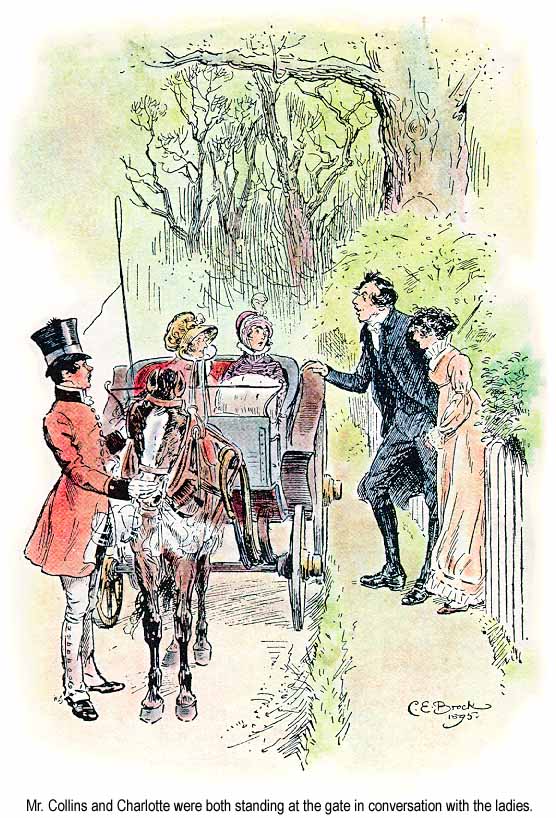
Pic: Charlotte Lucas and Mr Collins talking to Lady Catherine de Bourgh, from Pemberley

Sunday, 24 October 2010

Jane Austen Quote of the Week 131 by Linda

In Emma, Chapter 12, there is a mystery lurking for me. Maybe someone can shed some light on it for me. It seems that Emma is interjecting something to change the subject in the course of conversation. Here is the quote:

"I did not thoroughly understand what you were telling your brother," cried Emma, "about your friend Mr. Graham's intending to have a bailiff from Scotland, to look after his new estate. But will it answer? Will not the old prejudice be too strong?"

I am in the dark about the meaning of “the old prejudice be too strong”. The only thing I can think of is that the English harbor a prejudice of some kind against the Scottish. I get the sense that this must be the case, but is this really true? And if so, what is the nature of it?

Speaking of prejudices, I grew up with a certain prejudice which I overcame in my later years. What I discovered is that there is some good in the worst of us and some bad in the best of us. Also, wherever I travelled it seems that each group carried a prejudice against another group in the area. I learned to take each person on their own merit instead of simply lumping them all together. That’s my philosophy and I’m sticking to it!

I had to do a bit of research to discover what Emma meant by using the term ‘bailiff’. Wikepedia included this definition which I suspect comes closest to what she was speaking of. “Under the manorial system a bailiff was in charge of superintending the cultivation of the manor.”

So, if anyone can shed some light on this topic, I would be most grateful. And by the way, I am mostly English with one ancestor of Scottish origin and another one of German origin. No wonder I am always fighting with myself. ;-)

Yrs aff’ly,
Linda the Librarian

Pic: Kate Beckinsale's Emma

Thursday, 21 October 2010

Becoming Jane fanfic section in Fanfiction.net

I just found out that Fanfiction.net actually has a section for Becoming Jane the movie alone. It's here, and it has 26 stories there. Our Maria from Sweden is one the most prolific authoresses (if not THE most prolific one), I beleive, with 44 chapters (I Remember Love) and 303 reviews! Well done, Maria!

I think what I want to say is that it's been more than 3.5 years since I saw the movie in April 2007, but the movie still has followers and inspires many writers. Good job, Anne Hathaway and James McAvoy! And good job for Jane Austen and Tom Lefroy as well, in that sense.

Thursday, 14 October 2010

Jane Austen Quote of the Week - Week 130


I wanted to focus on a character who always seems to be in the background of Pride of Prejudice. - Mary Bennet. I have never quite understood Jane Austen's feelings towards Mary; she portray's her as quite plain and socially inept but also a great thinker. Do you thinks he saw some of herself in Mary?
The quote is from chapter 47 after Lydia has ran away with Wickham. Mary says to Lizzy:

"This is a most unfortunate affair; and will probably be much talked of. But we must stem the tide of malice, and pour into the wounded bosoms of each other the balm of sisterly consolation."

Then, perceiving in Elizabeth no inclination of replying, she added, "Unhappy as the event must be for Lydia, we may draw from it this useful lesson: that loss of virtue in a female is irretrievable—that one false step involves her in endless ruin—that her reputation is no less brittle than it is beautiful,—and that she cannot be too much guarded in her behaviour towards the undeserving of the other sex."


The definition of virtue is 'conformity of one's life and conduct to moral and ethical principles' and she is correct that Lydia's behaviour has indeed put her virtue into question if she does not marry Wickham. I think that the use of the word brittle suggests that no woman's virtue or reputation is ever secure, it is fragile.

My question is, have things changed so much in the past 200 years? In society today, all things are more accepted and some standards have been shattered. I do believe, however, that internally in most women there is still a code of conduct which when breached or jeopardised produces a great sense of disease for the woman.
On the other hand, this quote can still be considered current in the fashion of double standards with women being heavily criticised for actions that a man would be praised for.
Mary opens up an interesting debate on the way women are perceived in society today compared to Jane Austen's time.

I also really like the term 'the balm of sisterly consolation' - I think that this is something which has not changed over the past two centuries and is unlikely to change over two more.


Pic: First Novels Club

Sunday, 10 October 2010

Jane Austen Quote of the Week 129

This week, I chose a quote from Emma Vol 2 Chapter 16 as spoken by John Knightley to Jane Fairfax:


"Business, you know, may bring money, but friendship hardly ever does."


While I do not say that this quote does not capture the truth, I have to say that the reverse can be truthful, too. I have to say that I've seen people who scored their business deals because they had known their business partner(s) from a friend who attested to their merits. I am not trying to promote nepotism here. However, I do believe that a sincere friendship can invite a good business deal as well, so long as it is conducted in a fair and professional manner. Colonel Brandon offering Edward Ferrar a parish in Sense & Sensibility is a good example of my argument.


Thoughts?

Pic: Audiobook of Emma, read by Prunella Scales

Saturday, 2 October 2010

Jane Austen Quote of the Week 128

This weekend I chose a passage from Persuasion again, Chapter 9, when Anne Elliot was taking care of Little Walter (her nephew, Charles’ brother) and Captain Wentworth came into the room. Direct quote was taken from Pemberley.

There being nothing to be eat, he could only have some play; and as his aunt would not let him tease his sick brother, he began to fasten himself upon her, as she knelt, in such a way that, busy as she was about Charles, she could not shake him off. She spoke to him, ordered, entreated, and insisted in vain. Once she did contrive to push him away, but the boy had the greater pleasure in getting upon her back again directly.

"Walter," said she, "get down this moment. You are extremely troublesome. I am very angry with you."

"Walter," cried Charles Hayter, "why do you not do as you are bid? Do not you hear your aunt speak? Come to me, Walter; come to cousin Charles."

But not a bit did Walter stir.

In another moment, however, she found herself in the state of being released from him; some one was taking him from her, though he had bent down her head so much, that his little sturdy hands were unfastened from around her neck, and he was resolutely borne away, before she knew that Captain Wentworth had done it.

Her sensations on the discovery made her perfectly speechless. She could not even thank him. She could only hang over little Charles, with most disordered feelings. His kindness in stepping forward to her relief, the manner, the silence in which it had passed, the little particulars of the circumstance, with the conviction soon forced on her by the noise he was studiously making with the child, that he meant to avoid hearing her thanks, and rather sought to testify that her conversation was the last of his wants, produced such a confusion of varying, but very painful agitation, as she could not recover from, till enabled by the entrance of Mary and the Miss Musgroves, to make over her little patient to their cares, and leave the room.

There’s no particular quote I’d like to emphasize here, but the whole passage is amazing because it shows how the presence of a child can reconnect Anne and Wentworth, two lovers who became strangers because of the past. I can understand why people choose to have children then, although it should not be the only reason for an established relationship, of course.

Pic: Sally Hawkins as Anne Elliot (P2007) from Penny for Your Dreams

Friday, 1 October 2010

Becoming Jane persona from Maria

Thanks to Maria, we now have a very beautiful Becoming Jane persona!


Click here to access the file, and there may be more to come from our amazing artist in Sweden!

Friday, 24 September 2010

Jane Austen Quote of the Week - Week 127

It was the annual Jane Austen Festival in Bath this week and I was fortunate enough to go for a two days and a night at the beginning of the week.
Bath is the most amazing city, so beautiful. I took part in two of the organised activities; on monday night I attended a regency food tasting evening presented by a Jane enthusiast and it was most entertaining. There were a few people there in regency dress which was exciting. On the tuesday morning I went on an organised walk around where Jane would have walked herself during her time living in Bath (between 1801 and 1806). There are many activities organised over the week period such as dance lessons and balls so I am certain that I am going to go back next year and do more. This was just a taster.

I have attached various pictures with associated description. I have many of Bath so if you are interested to see more then do email me.

I photographed some of the recipes mentioned at the food talk so that you could see some examples of what Jane would have eaten during this time.


The young lady who presented actually had made her own variations of these recipes to taste which I actually didnt think were too bad! She did mention a few times how at the turn of the 19th century there was very limited storage and meat therefore went rancid very quickly so the meals were very rich in spices to try to conceal the rotten taste of the meat! I also thought that the use of language and variations in spelling was very interesting. One point raised was that recipes were not documented how we are used to, i.e. with a list of ingredients, instead it was often just a paragraph of words with little punctuation as seen in these photographs.

She also gave us a couple of recipes to take home for White Soup and Gooseberry Tart (email me if you would like a copy) and also made me aware of a poem called "Puddings Without Rhyme or Reason" written by Cassandra Austen (Jane's mother). It can be read on the Jane Austen Centre website . It makes us aware that Jane was not the only talented writer in the family.

The walk on tuesday morning started in Laura Place (where Lady Dalrymple - Sir Walter's cousin in Persuasion- lived) and walked up Great Pulteney Street towards Sydney Place where Jane Austen resided. There are two interesting facts about Great Pulteney Street; William Wilberforce lived here during the same period and it was highly likely that Jane and Cassandra would have passed him frequently on their walks. Also, Great Pulteney Street actually converges with a Henrietta Street at Laura Place. The mystical me is ignited here as Henrietta Street in Dublin houses the Law Library of King's Inns which holds the Stained glass window of Thomas Lefroy coat of arms ! I like finding signs when most would say it is just sheer coincidence.


Great Pulteney Street, Bath


Next we walked into Sydney Place and saw where Jane Austen and her family lived. There is a plaque on the wall. It still is a stunning part of Bath. The tour guide was explaining that rental prices in Great Pulteney Street where William Wilberforce lived would have been highly expensive and probably more than what the Austen's could afford. By simply walking 1 minute off the main street meant that they could afford to rent but still in the very plush and highly popular area of Bath. It was very very strange to stand on the steps where Jane herself would have stood. It was an amazing sense of uplifting.

The Austen's lease on 4 Sydney Place ended in 1804 and they moved to Green Park Buildings (no longer exists) and Mr Austen died a few months later. Mrs Austen, Cassandra and Jane lost their income and moved to lodgings at 25 Gay Street, which unfortunately I did not photograph but it is the same street as where The Jane Austen Centre now stands (pic below). They left Bath for good in 1806 to go to Southampton with Jane’s brother Frank and his family.


The next photos are just of the beautiful landscape surrounding where she lived. It fascinated me to consider how far she would have walked so frequently. There are lots of hills around there and wonderful areas to walk. We know she loved walking and she must have spent a great deal of time strolling considering she was not spending her time writing over this time which poses the question of what was going through her mind during these years?

The picture on the right shows where Sir Walter Elliot in Persuasion lived, Camden Place on the Crescent.

It is believed that Jane's uncle James Leigh-Perrot (her mothers brother) showed Jane the canal (seen in the picture on the bottom right)


The picture above left is of the pump rooms (next to the great Roman Baths) which Jane and her characters would have been very familiar with. Edward, Jane's brother, used the healing baths when he visited Bath as he was suffering from gout. Jane wrote in a letter to Cassandra...

'He was better yesterday than he had been for two or three days before...He drinks at the Hetling pump...is to bathe tomorrow.'
'Edward has been pretty well this last week, and as the waters have never disagreed with him in any respect, we are inclined to hope he will derive advantage from them in the end'.


I really like the lamp posts in Bath and I took care to take a photo with the one which had The Jane Austen Centre sign displayed. As mentioned above, The Jane Austen Centre is at 40 Gay Street, along the same street as Jane herself lived after her father died.

I ended my trip at St Swithin’s church, Walcot (below right), where Jane’s parents married and her father is buried.


I had a wonderful two days and I urge all of you to visit the wonderful city if you can. I end with my quote of the week, spoken by Catherine Morland to Mr Tilney in chapter 10 of Northanger Abbey:

"Oh! Who can ever be tired of Bath?"


Pics: Taken by myself 20th and 21st Sept 2010

Sunday, 19 September 2010

Answer to the Puzzle: Tom Lefroy's handwriting!

My dear friends, apologies for the very belated instalment of the puzzle. Thanks to Amy who has contributed the trivia and to Mimi who has wrecked her brain in trying to solve it (I wrecked my brain for 5min and gave up, hahaha!).


The above is the scanned image of a letter Amy posted to me, and this is the interpretation:

1st line: “Longford October …1836”

2nd line: “…Herries… &Co.”

3rd line: “St James St.”

4th line: “Lefroy London”

Amy’s note:
1. In the olden days, addresser was written on the left side
2. In 1836 , Messers Herries, Farquhar and Company was located on 16 St James Street, London. Some years later it was acquired by Lloyds Bank.

And the leading material that confirms that it was a letter from Thomas Langlois Lefroy (which we didn't post until now on purpose...):


“The Right Honble [Honourable] Thomas Lefroy”

Wikipedia entry of the University of Dublin confirms that "The Right Honourable" was Tom Lefroy's official title by 8 January 1835 (scroll down to 'Elections in the 1830s). The Memoir of Chief Justice Lefroy page 120 noted that in 1830, Tom Lefroy was first elected as the Representative of the University of Dublin. He contested again for a general election on 7 May 1831 and 18 December 1832. He won those elections (wow!) but he had not had "The Right Hon." in his title by then. It seems that Thomas Langlois Lefroy received "The Right Honourable" title somewhere between 1832 and 1835.

Anyway, it seems to me that the letter was indeed written by our Tom Lefroy. Thus this letter might be a specimen of his hand-writing!

Hope the trivia is enjoyable!

Friday, 17 September 2010

Jane Austen Quote Week 126

A friend of my friends passed away last week, leaving many of them shocked because of his sudden departure. While I do not know the deceased in person, I have ever since learned that he was a very amiable gentleman with a great sense of humour, a great father, and a loving husband. To him I dedicated this quote, which was taken from The Memoir of Chief Justice Lefroy page 386. The young Tom Lefroy was reminiscing the last moments of his late father’s life.

To the last he retained a cheerful and patient endurance under suffering which often elicited the astonishment and admiration of those who attended upon his sickness. I remember in his last illness (only two days before he was taken from us), after he had spent a very wearisome night from want of sleep, and great oppression of breathing, we closed the window-shutters in the morning, in the hope of his getting some sleep; just then the physician for whom an express had been sent, arrived from Dublin. After feeling his pulse, the doctor asked whether it would annoy him if the window-shutters were opened for a moment, when he replied with a cheerful smile, “not at all, doctor, I always like to have light thrown upon a subject.”

Apparently, Thomas Langlois Lefroy braced the last moments of his life in great courage and high spirit. May the friend of my friends also felt the same grace and spirit as Heaven opened up to him, and may he rest in peace.

Pic: the young Thomas Langlois Lefroy, private collection of Edward Lefroy

Sunday, 12 September 2010

Jane Austen Quote of the Week 125 by Linda


In Emma, Chapter 12, we find this quote:

"Why, pretty well, my dear, upon the whole. But poor Mrs. Bates had a bad cold about a month ago."

"How sorry I am! But colds were never so prevalent as they have been this autumn. Mr. Wingfield told me that he had never known them more general or heavy, except when it has been quite an influenza."

"That has been a good deal the case, my dear; but not to the degree you mention. Perry says that colds have been very general, but not so heavy as he has very often known them in November. Perry does not call it altogether a sickly season."

What I find intriguing about this passage is the talk of “colds” and “influenza”. Without making an extensive research, it amazes me that such afflictions were around in those days. For some reason, I have assumed that they were ‘modern’ afflictions. However, one brief excursion into the book “The English Physician” (1814) found the mention of ‘colds’. Jane’s mention of such everyday events are things that are so easy to overlook. It makes me wonder what else we have missed.

Yrs aff’ly,
Linda the Librarian


Friday, 3 September 2010

Jane Austen Quote of the Week - Week 124


I am told that it is the national Father's day in Australia this weekend so I thought that it was a good opportunity to pick a quote relating to fatherhood.

I have selected a series of rather long quotes from chapter 1 of Persuasion but I think that all are necessary to capture the dynamics of the Elliot family.

“Sir Walter’s continuing in singleness requires explanation. Be it known then, that Sir Walter, like a good father, (having met with one or two private disappointments in very unreasonable applications), prided himself on remaining single for his dear daughters’ sake. For one daughter, his eldest, he would really have given up any thing, which he had not been very much tempted to do. Elizabeth had succeeded at sixteen to all that was possible of her mother's rights and consequence; and being very handsome, and very like himself, her influence had always been great, and they had gone on together most happily. His other two children were of very inferior value. Mary had acquired a little artificial importance by becoming Mrs Charles Musgrove; but Anne, with an elegance of mind and sweetness of character, which must have placed her high with any people of real understanding, was nobody with either father or sister; her word had no weight, her convenience was always to give way - she was only Anne.”

“Vanity was the beginning and the end of Sir Walter Elliot's character; vanity of person and of situation. He had been remarkably handsome in his youth; and, at fifty-four, was still a very fine man. Few women could think more of their personal appearance than he did, nor could the valet of any new made lord be more delighted with the place he held in society.”

“Lady Elliot had been an excellent woman, sensible and amiable; whose judgement and conduct, if they might be pardoned the youthful infatuation which made her Lady Elliot, had never required indulgence afterwards.--She had humoured, or softened, or concealed his failings, and promoted his real respectability for seventeen years; and though not the very happiest being in the world herself, had found enough in her duties, her friends, and her children, to attach her to life, and make it no matter of indifference to her when she was called on to quit them.”

I think that these quotes capture insights into a series of roles within the family. I am an only child so have not had to experience some of the emotions brought to our attention in the first quoted paragraph. The last line is the most poignant for me:
"her word had no weight, her convenience was always to give way - she was only Anne."
To arrive at a state where it is easier to just give in than to fight for yourself and what you believe in is truly tragic. No-one should ever be made to feel this way.

The second quote makes us aware of the vanity and self-obsession that Sir Walter possesses. More interesting is the third quote which again paints a picture of a very familiar familial set up (both then and still in present society). Lady Elliot showed bravery and above all loyalty, demonstrated in the line: "she had humoured, or softened, or concealed his failings, and promoted his real respectability for seventeen years; and though not the very happiest being in the world herself."
Sir Walter's actions and personality allowed his daughter and his wife to feel deeply unhappy. I am sad for their situation but I marvel in the inner strength that both of these women clearly have to continue regardless with their head held high, as so many women must do.

Pic: Sir Walter and his daughters

Wednesday, 1 September 2010

A puzzle

A friend from Singapore (Amy) sent us this piece of letter. Truly a piece of a letter, very old, and might be attributed to one of Jane's acquaintance, or even Jane Austen herself.


Guess what was written in this piece of paper? Try to type it on the comment section so that we can see which one has the best guess. No prize this time for the winner, but hey, it's a fun thing to do!

The answer will be posted (along with a rather long story of how Amy found this letter) next week, before the weekend.

Good luck and have fun! And thanks a lot Amy for contacting us!

Sunday, 29 August 2010

Jane Austen Quote of the Week 123


My apologies for the rather late installment for this week's quote. I originally wanted to pull something from the Memoir of Chief Justice Lefroy, but after contemplating, I chose another quote from Emma, chapter 21 when Mr Woodhouse was contemplating the pleasant evening they just had.

"I hope every body had a pleasant evening," said Mr. Woodhouse, in his quiet way. "I had. Once, I felt the fire rather too much; but then I moved back my chair a little, a very little, and it did not disturb me. Miss Bates was very chatty and good-humoured, as she always is, though she speaks rather too quick. However, she is very agreeable, and Mrs. Bates too, in a different way. I like old friends; and Miss Jane Fairfax is a very pretty sort of young lady, a very pretty and a very well-behaved young lady indeed. She must have found the evening agreeable, Mr. Knightley, because she had Emma."

"True, sir; and Emma, because she had Miss Fairfax."

Emma saw his anxiety, and wishing to appease it, at least for the present, said, and with a sincerity which no one could question --

"She is a sort of elegant creature that one cannot keep one's eyes from. I am always watching her to admire; and I do pity her from my heart."


We all know that Emma is jealous of Jane Fairfax, and perhaps for a good reason for everyone always loves to talk about Jane's merits. Being a rather spoiled (but actually golden-hearted) girl, Emma forgets that everyone has his/her own merits. 'Just' because everyone is praising Jane Fairfax, doesn't mean that she has nothing to be proud of. If anything, Emma's desire to mend the fences after insulting Miss Bates is something of a good quality for her. Also her willingness to (eventually) listen to Mr Knightley (albeit grudgingly). Emma's tremendous care and love for her father is something that caught my attention as well.

I guess what I want to say is, there was a reason for me picking this quote too. I have a tendency to compare myself with others, and unwillingly get jealous of him/her. I am now trying to learn to admit other's positive characteristics and talents... while at the same time also try to understand that I also have good things that I can contribute to others. For everyone is unique and has his/her own place in this world.

Does it make sense? I hope it makes sense...

Pic: 2009 Jane Fairfax and Emma Woodhouse (Romola Garai)

Friday, 20 August 2010

Jane Austen Quote of the Week - Week 122

We were deliberating whether we should keep these quote of the week dedicated to words only written by Jane Austen but we thought that it would be ok, on occasion and not too regularly, to include quotes made by other prominant people in Jane's life. So who better to start with than Tom Lefroy.

This is taken from a letter he wrote to his wife Mary in 1801. It is written in his memoirs, page 29 - 30. The title of the letter is: To His Wife (Mountrath, Friday night).

"I do not say that we are to extinguish the affections which belong to the different relations of life; on the contrary, by the pure and sincere exercise of them, selfishness is in some degree extinguished, but the gratification arising from the most delightful of these affections should not form the stay, and hope, and prop of life. No; therein consists the excess and the abuse: but I’ll say no more on this head, lest you should tell me that nothing but my vanity could suggest the necessity of sermonizing you in this manner. I own, however, it is grounded on a conviction that the sensibility and devotedness of my darling wife’s attachment to a certain degree impair her own enjoyment. But, remember, I am not willing to part with the least atom of it to any earthly object; whatever of it ought to be pruned away, let it be transplanted to that region where we may hope and trust to enjoy it in bliss unfading."
I think that this quote lends to lots of different interpretations. I think that it is clear to say that he knows what love means. I like to believe he is saying that love is ultimate selflessness and is aiming to distinguish between the short term gratifications arising from a lustful relationship and the long term foundations which develop a truly loving relationship. He goes on to state that Mary is obviously a highly devoted and attentive wife and he fears that her own enjoyment is impaired by such actions. He does not want her regard for him to diminish, only for it to be translated to another form in which they both can enjoy it forever.

I think that this quote demonstrates his awareness of matters of the heart. My interpretation may be very different from others so I welcome comments and alternatives.


Pic: Tom Lefroy

Sunday, 15 August 2010

Mariana's UK videos

The followings are Mariana's YouTube videos she made based on her recent trip to UK. This is an excerpt of her note:

"I’ve only started to learn how to use Windows Movie Maker the week before leaving on vacation. These are my first videos, nothing really fancy, just a compilation of the pictures and short clips I captured/recorded during my journey and wanted to share them with you. Icha my dear, these videos are especially dedicated to you. I truly hope and wish in the near future you will be able to make this journey, not only through my eyes or the help of Internet."

Hope you enjoy the video as much as I do!

From London to Alton:


Chawton:


The Bakehose and the Garden


The House - the Drawing Room


Thank you so much Mariana!


Jane Austen Quote of the Week 121

Inspired by the meeting between Rachel and Mariana last week, this week I chose a quote about friendship. From Northanger Abbey chapter 4 when Catherine was anxiously waiting for Mr. Tilney to arrive at the Pump Room, yet his presence was nowhere to be found.


The whole being explained, many obliging things were said by the Miss Thorpes of their wish of being better acquainted with her; of being considered as already friends, through the friendship of their brothers, etc., which Catherine heard with pleasure, and answered with all the pretty expressions she could command; and, as the first proof of amity, she was soon invited to accept an arm of the eldest Miss Thorpe, and take a turn with her about the room. Catherine was delighted with this extension of her Bath acquaintance, and almost forgot Mr. Tilney while she talked to Miss Thorpe. Friendship is certainly the finest balm for the pangs of disappointed love.

Of course I hope we don't only need friendship when we have disappointment in love. Certainly to me, friendship is very much treasured in any situation whatsoever.

But it is true that friendship endures us. Here I translate 'love' as general love, not only between a man and a woman. Our love to life is also love... and at times, such love is also tested. At times, I also wonder where my life will lead me, and will I have enough faith that I shall be okay... that all will be okay... And at such times, in addition to my faith to myself and the Power That Be, the presence of my friends also sustains me.

To my dearest Mariana who shall read this soon: Have Faith my dearest. We all have our troubled times, and yours too shall past, with clearer sky above your head to shine upon your smiling countenance.

love always,
Icha

Pic: Felicity Jones (Catherine Morland) from Northanger Abbey 2007

Thursday, 12 August 2010

Meeting Mariana

After being good friends through this blog for a long time now, I finally managed to meet one of the blog's most loyal fans. Marianna and her husband visited England and Jane Austen's homeland last week and I was fortunate enough to meet up with them at the airport before their return home.


It nearly didnt happen (sorry guys!) but I am so glad that it did, even if it was far too short. Both Marianna and her husband are such wonderful people and I am so happy that I had the time I did to chat with them. I was furnished with gifts from Canada and embraced with such care and warmth.

Mariana, your passion for Jane is uplifting and exciting. I really do hope that you can come here again and we can explore more of Jane's life together. Icha, Linda, Michelle and our other loyal friends, you are most welcome too. I have faith that one day it will happen and I am already excited.

Sunday, 8 August 2010

Jane Austen Quote of the Week 120

This weekend I choose a famous quote from Marianne Dashwood that echoes what has been happening to my life. Although Marianne was in her reckless age when she uttered it, there is a grain of truth there, and some of them applies to me now. Sense & Sensibility Chapter 12:

It is not time or opportunity that is to determine intimacy it is disposition alone. Seven years would be insufficient to make some people acquainted with each other, and seven days are more than enough for others.

I met someone about two months ago, and we started seeing each two weeks after. We're going steady. Externally, our development may be considered as being too quickly, but I just think that it's the right time. This is where I agree and disagree at the same time with Marianne. Timing is also important, opportunity is also important. We would not have come this far had we not met at the right time, moment, setting, etc. Of course our dispositions, i.e. our characters is also an important factor, but we both agree that had we met six months ago or so, this would not happen. It was not the right time.

But now, it is the right time. We're of the right age and maturity to move on. And I'm very grateful for every moment I spend with him.

May Love, in whatever forms, graces you all.

Pic: Lovely Kate Winslet as Marianne Dashwood

Friday, 30 July 2010

Jane Austen Quote of the Week 119

The theme of trust to Icha's quote from last week stayed with me and I have been thinking about it often the last few days.

I do agree with her observation that it is beneficial to place a degree of trust in a person to begin a relationship but I also think that it is crucial to balance this with awareness and vigilance (as Linda stated in the comments) to ensure that you do not get deceived and consequently hurt.

This led me to think about Elizabeth in Pride and Prejudice. Upon first meeting Wickham, she trusted him. She believed everything he said to be true.
Conversely, she did not like Mr Darcy. Of course he did not present her with many attributes in which she could like but she didnt trust him.
It is not until chapter 36 of the novel when she reads the letter written to her by Darcy and she starts to have her doubts.
She finds his arrogance insulting:

"He expressed no regret for what he had done which satisfied her; his style was not penitent, but haughty. It was all pride and insolence."

The letter does however sew some seeds of doubt regarding the true nature of Wickham:


"How differently did everything now appear in which he was concerned! His attentions to Miss King were now the consequence of views solely and hatefully mercenary; and the mediocrity of her fortune proved no longer the moderation of his wishes, but his eagerness to grasp at anything."

Overall, she is confused and does not know what to think. All she knows is that:

"She grew absolutely ashamed of herself. Of neither Darcy nor Wickham could she think without feeling that she had been blind, partial, prejudiced, absurd. -"

I think my point is that both trusting and not trusting is dangerous. She feels ashamed for misplacing her trust but it is a common mistake for us all. But to place no trust at all in a person can lead to a very lonely life ...

In chapter 44 after she has seen Mr Darcy at Pemberley, Elizabeth is beginning to acknowledge her positive feelings for him; her trust in his good nature is growing:

"The respect created by the conviction of his valuable qualities, though at first unwillingly admitted, had for some time ceased to be repugnant to her feelings; and it was now heightened into somewhat of a friendlier nature by the testimony so highly in his favour, and bringing forward his disposition in so amiable a light, which yesterday had produced."

Sorry for using so many quotes but I thought they all illustrated the point that we must place trust in people to make mistakes, learn and grow as a person.

Pic: Wickham and Darcy