Monday, 14 September 2009

Emma 2009 Trailer & UK Screening Date ...

Sorry for the belated news about the BBC's Emma 2009, but the word is that the series will begin screening in the UK on the 4th of October!

Edit: Google's just informed me that the DVD is available for pre-order on the BBC shop, with the release date of 30th November: pre-order Emma.

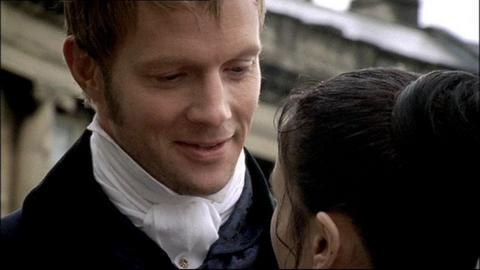
And finally ... I haven't seen any new pictures (where are they all?!) but here is the trailer :)

Saturday, 12 September 2009

Scent of Sensibility!!

For any of you, like me, who like the aroma of old books, then look no further. There is a room scent which has captured and recreated the early 18th century. The scent is a mix of violets, horses, and potpourri.

It costs £9.99- around $16.70 to purchase from Smell of Books and I believe it is on sale at a number of other sites.

I am intrigued.......If anyone decides to try it out, let us know what you think.


Friday, 11 September 2009

Jane Austen Quote of the week- Week 73

This week I have chosen a quote from Chapter 9 of Mansfield Park. Mrs Rushworth is showing Fanny, Edmund and Miss Crawford around the house and upon arriving at the chapel, there is some witty exchange between them. Edmund states:

"At any rate, it is safer to leave people to their own devices on such subjects. Everybody likes to go their own way—to chuse their own time and manner of devotion. The obligation of attendance, the formality, the restraint, the length of time—altogether it is a formidable thing, and what nobody likes; and if the good people who used to kneel and gape in that gallery could have foreseen that the time would ever come when men and women might lie another ten minutes in bed, when they woke with a headache, without danger of reprobation, because chapel was missed, they would have jumped with joy and envy."

Fanny is angered by Edmunds open and clever display of disagreement. I love this example of the chemistry between them.

I also simply love the line bolded above. Even in our modern day, I think it is still all too easy to try to please everyone all of the time and to strive to consistently meet rules and conventions. Sometimes it is nice to just be how we want to be and do what we want to do without this pressure. Choice is such a powerful thing and I think that we should sometimes not be so afraid to be free.

Pic 1: Austen Prose

Saturday, 5 September 2009

Jane Austen Quote - Week 72 by Linda


In Sense and Sensibility, tucked away in Chapter 44, Jane Austen has given us a character lesson to be heeded when rearing children. These are Elinor’s thoughts after Willoughby’s confession when he heard that Marianne was dying:


QUOTE

Elinor made no answer. Her thoughts were silently fixed on the irreparable injury which too early an independence and its consequent habits of idleness, dissipation, and luxury, had made in the mind, the character, the happiness, of a man who, to every advantage of person and talents, united a disposition naturally open and honest, and a feeling, affectionate temper. The world had made him extravagant and vain; extravagance and vanity had made him cold-hearted and selfish. Vanity, while seeking its own guilty triumph at the expense of another, had involved him in a real attachment, which extravagance, or at least its offspring necessity, had required to be sacrificed. Each faulty propensity, in leading him to evil, had led him likewise to punishment. The attachment, from which against honour, against feeling, against every better interest he had outwardly torn himself, now, when no longer allowable, governed every thought; and the connection, for the sake of which he had, with little scruple, left her sister to misery, was likely to prove a source of unhappiness to himself of a far more incurable nature. From a reverie of this kind she was recalled at the end of some minutes by Willoughby, who, rousing himself from a reverie at least equally painful, started up in preparation for going, and said:

"There is no use in staying here; I must be off."

END OF QUOTE

There are so many ‘treasures’ Jane scattered throughout her novels that one has to carefully read each page. As the teacher/caretaker for my grandchildren, it behooves me to take her admonitions to heart. I can see that her Father, the clergyman at Steventon, probably had much to say on these subjects, especially as he was a tutor to young boys.

Linda the Librarian

Pic: Dominic Cooper as Willoughby in Sense & Sensibility 2008, from Jane Austen's World

Tuesday, 1 September 2009

Jane Austen Festival, Bath

For all you UK Janeites out there (and for anyone else who is interested!), I just wanted to make you all aware that it is in fact the Jane Austen festival in Bath in a few weeks.


The festival runs from Friday 18th September to Sunday 27th September and there are many events running every day, e.g. walking tours, talks, dancing (regency costume most welcome).


It is worth checking out the homepage for more information.
I have been to the Jane Austen centre in Bath and that is well worth a visit, even at non-festival times.
I am desperately hoping to be able to get to the festival at some point over the 10 days.
I want to meet my very own Tom Lefroy!

Zombie Chicken Awards!!

Yes I know the name seems rather strange but I am happy to announce that Clare from My Pride and Prejudice site has nominated us for a 'zombie chicken award' to recognise our contribution as a blog.

Taken from Clare's blog, 'The blogger who receives this award believes in the Tao of the zombie chicken – excellence, grace and persistence in all situations, even in the midst of a zombie apocalypse. These amazing bloggers regularly produce content so remarkable that their readers would brave a raving pack of zombie chickens just to be able to read their inspiring words. As a recipient of this world-renowned award, you now have the task of passing it on to at least 5 other worthy bloggers. Do not risk the wrath of the zombie chickens by choosing unwisely or not choosing at all.'

I have to say, I am not quite sure what that means but in response we thought it only right to make 5 of our own nominations; Linda, Icha and I have compiled the following list (in no particular order):

1. Jane Odiwe's website: http://www.janeodiwe.blogspot.com/


3. Caroline from Dregston: http://jarelated.blogspot.com/

4. Friend from Dregston, JaneGS: http://janegs.blogspot.com/

5. WilliamL from Pemberley: http://sharkubillspemberley.blogspot.com/

Comments are most welcome. Thanks again Clare for the nomination!

Saturday, 29 August 2009

Jane Austen Quote - Week 71


This week's quote is again from Persuasion (I promise to get another book next time...), for it just suddenly clicked with me when I opened the book. I took it from Oxford World's Classics version 2003, p. 148 (Chapter 20, or Volume II Chapter VIII). This is when Anne Elliot conversed with Capt. Wentworth about Capt. Benwick's new attachment (and engagement) to Louisa Musgrove. Wentworth was still rather surprised at their engagement and said,

'I confess that I do think there is a disparity, too great a disparity, and in a point no less essential than mind. I regard Louisa Musgrove as a very amiable, sweet-tempered girl, and not deficient in understanding, but Benwick is something more. He is a clever man, a reading man; and I confess, that I do consider his attaching himself to her with some surprise. Had it been the effect of gratitude, had he learnt to love her, because he believed her to be preferring him, it would have been another thing. But I have no reason to suppose it so. It seems, on the contrary, to have been a perfectly spontaneous, untaught feeling on his side, and this surprises me. A man like him, in his situation! with a heart pierced, wounded, almost broken! Fanny Harville was a very superior creature, and his attachment to her was indeed attachment. A man does not recover from such a devotion of the heart to such a woman. He ought not; he does not.'

Oh.... what can I say...? The passage brought me to Persuasion 2007 when Rupert Penry-Jones as Wentworth uttered those words as he clenched his jaws in determination... sigh... And Wentworth might actually want to say that in his own circumstances, he would not be able to forget such a woman in his life, namely Anne herself.

Sigh...

PS: I just realised that this quote actually resonates well with Rachel's last week. In Rachel's choice of quote, it was Anne who claimed that a woman loves the most. Now in this week's quote, Capt. Wentworth was the one who said that a man could not, should not forget the love of his life. In the end, I think both were correct.

Pic: Wentworth (Rupert Penry-Jones) looking lovingly at Anne Elliot (Sally Hawkins) from Jimandellen.org

Saturday, 22 August 2009

Jane Austen Quote - Week 70 by Rachel

In Week 43 I chose a quote from Chapter 23 of Persuasion in which Anne and Captain Harville are having a discussion on the differences between the male and female heart. I took it from the point where Captain Wentworth walked in the room but I realised that we haven't referenced the exchange before this moment which is equally as interesting and beautiful. Anne and Capt. Harville are actually discussing the shattered Captain Benwick who loved Captain Harville's deceased sister, Fanny, very deeply.

"True," said Anne, "very true; I did not recollect; but what shall we say now, Captain Harville? If the change be not from outward circumstances, it must be from within; it must be nature, man's nature, which has done the business for Captain Benwick."

“No, no, it is not man's nature. I will not allow it to be more man's nature than woman's to be inconstant and forget those they do love, or have loved. I believe the reverse. I believe in a true analogy between our bodily frames and our mental; and that as our bodies are the strongest, so are our feelings; capable of bearing most rough usage, and riding out the heaviest weather."

"Your feelings may be the strongest," replied Anne, "but the same spirit of analogy will authorise me to assert that ours are the most tender. Man is more robust than woman, but he is not longer lived; which exactly explains my view of the nature of their attachments. Nay, it would be too hard upon you, if it were otherwise. You have difficulties, and privations, and dangers enough to struggle with. You are always labouring and toiling, exposed to every risk and hardship. Your home, country, friends, all quitted. Neither time, nor health, nor life, to be called your own. It would be hard, indeed" (with a faltering voice), "if woman's feelings were to be added to all this."


This is just true mastery and is openly dealing with the issue of gender differences which is a common theme in many of Jane's novels. Anne is so confident in her view and so eloquent in her delivery....she really puts him in his place. I would love to know what you all think of this part of the novel."

Pic: Mollands

Saturday, 15 August 2009

Jane Austen Quote - Week 69 by Linda


In Sense and Sensibility, Chapter 17, Edward says:

“…I never wish to offend, but I am so foolishly shy, that I often seem negligent, when I am only kept back by my natural awkwardness. I have frequently thought that I must have been intended by nature to be fond of low company, I am so little at my ease among strangers of gentility!”

"Marianne has not shyness to excuse any inattention of hers," said Elinor.

"She knows her own worth too well for false shame," replied Edward. "Shyness is only the effect of a sense of inferiority in some way or other. If I could persuade myself that my manners were perfectly easy and graceful, I should not be shy."

"But you would still be reserved," said Marianne, "and that is worse."

Edward stared -- "Reserved! Am I reserved, Marianne?"

"Yes, very."

"I do not understand you," replied he, colouring. "Reserved! -- how, in what manner? What am I to tell you? What can you suppose?"

Elinor looked surprised at his emotion, but trying to laugh off the subject, she said to him, "Do not you know my sister well enough to understand what she means? Do not you know that she calls every one reserved who does not talk as fast, and admire what she admires as rapturously as herself?"

Edward made no answer. His gravity and thoughtfulness returned on him in their fullest extent -- and he sat for some time silent and dull.

END OF QUOTE


One may take this as a definition from JA for ‘reserved’ and ‘shy’. Yes? No? At another site, there is quite a war about the shy controversy. Personally, I like the above definitions even though we may call it speculation.


Linda the Librarian


Pic: Edward Ferrars, from this site

Saturday, 8 August 2009

Jane Austen Quote Week 68

I have a new-found obsession – ehm – hobby, about shoes recently. Well, I mean, I’m always so fond of boots, gladiator sandals, espadrilles, or sling-backs with cords, but I never thought until last week (very belatedly) how lovely a pair of graceful pump or court shoes can be, provided that their heels are of sensible height! So I did some reading, and found out that Jane Austen also loved shoes. Well, that shouldn’t be a surprise. Being very fond of dancing herself, she must have loved shoes as well! And apparently, having the correct pair of shoes was essential to keep one healthy, as it is today. Wonder if the Regency ladies thought of high heels as deterrent to healthy spines, though…

So the followings are several quotes about shoes in Jane Austen’s novels, and also some pictures of cute period shoes. Nothing heavy this time, just pretty things.

Pride & Prejudice, chapter 28

From his garden, Mr. Collins would have led them round his two meadows, but the ladies, not having shoes to encounter the remains of a white frost, turned back;

Sense & Sensibility, chapter 36

The impertinence of these kind of scrutinies, moreover, was generally concluded with a compliment, which, though meant as its douceur, was considered by Marianne as the greatest impertinence of all; for after undergoing an examination into the value and make of her gown, the colour of her shoes, and the arrangement of her hair, she was almost sure of being told, that "upon her word she looked vastly smart, and she dared to say she would make a great many conquests."

Sense & Sensibility, chapter 42

Two delighted twilight walks on the third and fourth evenings of her being there, not merely on the dry gravel of the shrubbery, but all over the grounds, and especially in the most distant parts of them, where there was something more of wildness than in the rest, where the trees were the oldest, and the grass was the longest and wettest, had- assisted by the still greater imprudence of sitting in her wet shoes and stockings- given Marianne a cold so violent as, though for a day or two trifled with or denied, would force itself by increasing ailments on the concern of every body, and the notice of herself.

Mansfield Park, chapter 36, speaks Mary Crawford:

Poor Margaret Fraser will be at me for ever about your eyes and your teeth, and how you do your hair, and who makes your shoes

Emma, chapter 15, speaks Isabella Woodhouse:

"You had better order the carriage directly, my love," said she; "I dare say we shall be able to get along, if we set off directly; and if we do come to any thing very bad, I can get out and walk. I am not at all afraid. I should not mind walking half the way. I could change my shoes, you know, the moment I got home; and it is not the sort of thing that gives me cold."


Emma, chapter 19

Mrs. and Miss Bates occupied the drawing-room floor; and there, in the very moderate-sized apartment, which was every thing to them, the visitors were most cordially and even gratefully welcomed; the quiet neat old lady, who with her knitting was seated in the warmest corner, wanting even to give up her place to Miss Woodhouse, and her more active, talking daughter, almost ready to overpower them with care and kindness, thanks for their visit, solicitude for their shoes, anxious inquiries after Mr. Woodhouse's health, cheerful communications about her mother's, and sweet-cake from the beaufet –

Emma, chapter 32

She could not enter the house again, could not be in the same room to which she had with such vain artifice retreated three months ago, to lace up her boot, without recollecting. A thousand vexatious thoughts would recur.

Northanger Abbey, chapter 3, speaks Mr. Tilney:

"Yes, I know exactly what you will say: Friday, went to the Lower Rooms; wore my sprigged muslin robe with blue trimmings--plain black shoes—appeared to much advantage; but was strangely harassed by a queer, half-witted man, who would make me dance with him, and distressed me by his nonsense."

Persuasion, chapter 19

The rain was a mere trifle, and Anne was most sincere in preferring a walk with Mr Elliot. But the rain was also a mere trifle to Mrs Clay; she would hardly allow it even to drop at all, and her boots were so thick! much thicker than Miss Anne's; and, in short, her civility rendered her quite as anxious to be left to walk with Mr Elliot as Anne could be, and it was discussed between them with a generosity so polite and so determined, that the others were obliged to settle it for them; Miss Elliot maintaining that Mrs Clay had a little cold already, and Mr Elliot deciding on appeal, that his cousin Anne's boots were rather the thickest.


PS: Quotes were easily grabbed from Online Literature.

Pic 1: beautiful green Venetian court shoes from The Bata Museum
Pic 2: lovely purple Regency pump shoes from Jane Austen Centre UK
Pic 3: elegant yellow pumps from the Jane Austen World

Friday, 7 August 2009

Another beautiful wallpaper from Maria!

Maria strikes again! This time, the wallpaper is lavishly adorned with dusky pink colours (my favourite at the moment, actually!) and it has such a beautiful romantic tone. What do you think, Ladies and Gents? Charming, is it not?

Thank you so much, Maria!

Friday, 31 July 2009

Quote of the Week- Week 67

I have stuck with our faithful friend Emma for this weeks quote as there are an unlimited number of gems that everyone should have the pleasure of enjoying.
This quote is taken from Chapter 5 when Mr Knightley and Mrs Weston are discussing the friendship between Harriet Smith and Emma. Mrs Weston believes it to be a beneficial thing for both Emma and Harriet but Mr Knightley finds the opportunity to comment on Emma's faults.


"Emma has been meaning to read more ever since she was twelve years old. I have seen a great many lists of her drawing up at various times of books that she meant to read regularly through--and very good lists they were--very well chosen and very neatly arranged--sometimes alphabetically and sometimes by some other rule. The list she drew up when only fourteen--I remember thinking it did her judgement so much credit that I preserved it some time; and I dare say she may have made out a very good list now. But I have done with expecting any course of steady reading from Emma. She will never submit to anything requiring industry and patience and a subjection of the fancy to the understanding."

I have to say that I completely adore the last line; its so Emma! He completely 'gets her' with such a descriptive and beautiful set of words.
And this line definitely makes me chuckle as I have to confess, I am a list writer and I have been known in my time to avoid the task at hand by writing a list, clearly describing the actions required to complete the task!

We have tended to favour taking pics from the Kate Beckinsale version of Emma (for TV) so I have chosen a great pic from the Gwyneth Paltrow film version (both 1996 productions).

Pic: Emma and Mr Knightley

Monday, 27 July 2009

Rude Awakenings of a Jane Austen Addict

This is a very belated review of another excellent book from Laurie Viera Rigler. Rachel has reviewed Laurie’s previous book (Confessions of a Jane Austen Addict) exactly two years ago, the post can be found here. For those who have not read the first book and are interested in jumping through the second book directly, I have to advise against it, for it’s important to know the previous plots to fully understand the story in ‘Rude Awakenings of a Jane Austen Addict’. It is possible, of course, to enjoy ‘Rude Awakenings’ without first reading ‘Confessions’, but I still think it increases the chance of being confused.

Okay, so in Confessions, a young Californian girl Courtney Stone woke in the body of a young Regencial British Jane Mansfield. The year was set back nearly 200 years, from 2007 to 1813. Rachel has explained everything in her review, so I won’t reiterate the plot here. I have to say though, that I really enjoyed Confessions; I remember reading it in one night, couldn’t put it down, and had to wake up dizzily the next morning from the lack of sleep. I do admit that I was a bit confused with the ending, for [spoilers for those who haven’t read Confessions], it seemed that Courtney had totally forgotten that she was Courtney. Instead, she was now 100% a believer that she was Jane Mansfield instead, living happily ever after with her ‘Mr. Darcy’, a dashing man named Edgeworth who was the real beau of the real Jane Mansfield. How about Jane herself then? How was/is she doing in 2007?

Now, Rude Awakenings catches the tails of this body/life switch. But instead of 2007, Laurie moved the year forwards to 2009. Could it be because it would be much up to date to talk about California in 2009 than 2007? Perhaps because it was more tempting to include up to date stuffs like the amazing development of United States politics a.k.a. Barack Obama than talking about the previous administration? I’d like to think so… for I see no reason for Courtney to have her head injured in a swimming pool in 2007, switch body with Jane in 1813, and then Jane of 1813 woke up in Courtney’s 2009 body. Courtney’s friends kept suggesting that the (assumingly same) swimming accident pool had triggered Jane’s, eh Courtney’s, senses to take a leave of absence, so logically, Jane should wake up in 2007 as well, instead of 2009.

Anyway, aside from that hiccup, I think Rude Awakening is an excellent book. What I enjoyed the most was Jane’s different perceptions of what is right or wrong, agreeable or disagreeable, beautiful and not beautiful. Jane Mansfield was totally amazed at the many convenience of 21st century, including the wonderful brassiere that was non existent in the early 19th century. She thinks that Courtney’s body is beautiful, complete with the slender swells, and her appreciations upon her ‘own’ body makes her friends happier, for they always attempted to make Courtney realize how beautiful she is, just as she is.

Jane was also bedazzled by the gigantic portions of modern breakfast (funny, I always thought Regencial breakfast as extravagant as well, judging from Pride & Prejudice etc…) and thought that modern humans tend to waste so much food and garbage (that I agree!). And what amazing inventions are computer and internet! Google is just incredibly helpful for Jane to understand Courtney’s world and traditions, even to understand various leaps in human history (I wonder if Jane would ever decide to visit her old village in England… the village still exists per her Google search). And wouldn’t it be fun to see how Jane addresses the amazing shopping trend called Ebay? She might decide to order a Regencial dress online and get addicted with online shopping! (speaking of true experience here…). Oh, and to find herself living the life of another Jane Austen fan, who possesses not only the authoress’ complete novels but also the adapted movies as well! What a joy! To quote Miss Bates: ‘Lovely, lovely, lovely!’

But there are other, more pressing matters for Jane to consider. Was it right for her to go out with a man without a chaperon, even if the said man claimed to be her good friend Wes? Was it even right for her to kiss another man who claimed to be his former fiancé? What about living together and premarital sex? And why – most importantly – does she have to live Courtney’s life as Courtney lives hers? What lessons must she learn?

And this sets the book to another psychological level, as Rachel also admitted in her 2007 review. Does Jane experience reincarnation or mere delusions? Will she ever wake up one day in her own body again? Meanwhile, how does she earn her own bread, now that she decided to quit her old, miserable job? Would it be proper indeed, for a gentleman’s daughter to work at all? What of Frank, Courtney’s former fiancé that kept begging her to forgive and accept him back? What of dearest Wes?

As I hoped, Rude Awakenings does a good job in tying up loose ends from the Confessions (which, I should have known, were left behind intentionally for a sequel). Apart from the 2007/2009 confusion, that is. But no matter. Jane learned a lot of herself, learned new things for her self development. Of the new meaning of independence. Of being a true woman. Of holding her own in the rough life of 21st century. Of cellular memories and the power to choose to be happy; to break old patterns. For she, as all Austen heroines, as Jane Austen herself, finally chooses to empower herself. To set herself free. To be independent, to be happy.

So I guess in the end, I am very thankful for Laurie to have written the book. I’ve written a personal post here, based on the lessons I received from this book (and from other books). And allow me to cite some very impressive quotes from Rude Awakenings here:

‘Today’s women are no less desirous of love, and marrying for love, than they were in [Jane’s] time. But they, like so many women before them, simply fear it is an unattainable goal. And thus they settle for what fleeting pleasures they can find, creating an endless cycle of pleasure, despair, pleasure, despair, ad infinitum.’ (p. 278)

‘In the eyes of love, there is no past.’ (p. 281)

‘Each of us has the power to create heaven or hell, right here, right now.’ (p. 284)

With that note, what’s left for me is suggesting that you should buy the book. Or at least, borrow your friend’s copy if the Amazon’s copy is slow in arriving. It’s an enlightening experience.

Pic: Cover to 'Rude Awakenings of a Jane Austen Addict', from Amazon.com

Update 28 July09:
Laurie has just emailed me to thank for the review and to explain about the 2007/2009 stuff. This is her reply verbatim: "Nowhere in the first book is the year 2007 ever mentioned, except on the copyright page. Besides, as the fortune teller told Courtney, time is not linear."

Ah, I see now. I think Rachel and I just assumed 2007 because Confessions was written in 2007. Time is indeed not linear, but if Laurie did mention 2007 in her book, then it would be harder to bring Jane right into 2009 with Courtney's exact chronological life (including the cancelled wedding and swimming pool accident). So it's really good on Laurie's part not to mention the year 2007 at all in Confessions, deliberate for sequel or not!

Of course if she did so, we can always go to the alternative timeline. As a Star Trek fan, it wouldn't be so hard for me to accept it...

Maria's lovely wallpaper!

Maria of Sweden has been very productive as of late. In addition to the lovely banners, she also made this simple but charming wallpaper for us all to use.


I love the feeling that it was taken from Jane Austen's old diary... withered and yellowish (brownish, even), but so full of memories. Its size is 1024x768 px; but Maria can also make the 1280x800 pixels upon request.

Thanks so much, Maria!

Sunday, 26 July 2009

Becoming Jane Banners!!

We would like to say a HUGE thank you to Maria for making such fantastic Becoming Jane banners for use on the blog.
I have to say they are exceptional and she has made a great choice in images. My favourite is Jane poised over the fence.

As you can see Icha has already displayed the first banner at the top of the page and this will be rotated with the other in due course.

Thanks again Maria.

Saturday, 25 July 2009

Jane Austen Quote - Week 66 by Linda

From Chapter 43 in “Pride and Prejudice”, Elizabeth Bennet and the Gardiners are at Pemberley where they are joined in their walk about the grounds by Mr. Darcy. It appears that Mr. Darcy’s attitude towards the Gardiners is quite civil.


Elizabeth said nothing, but it gratified her exceedingly; the compliment must be all for herself. Her astonishment, however, was extreme, and continually was she repeating, "Why is he so altered? From what can it proceed? It cannot be for me -- it cannot be for my sake that his manners are thus softened. My reproofs at Hunsford could not work such a change as this. It is impossible that he should still love me."


In the margin of my paperback, I wrote, “Do reproofs really work?” Under that I wrote, “On a healthy mind!”


To understand my thinking, you must realize that I have known quite a few people, and I won’t mention their gender, to whom one could talk for a million years and they would not hear you. They “know” everything! But then I realized that Mr. Darcy was not suffering from the ailments of those persons I know. It amazes me how many of human nature’s idiosyncrasies appear in Jane Austen’s novels. It says one more time that people have not changed in hundreds of years.


When will we ever learn?


Linda the Librarian


Pic: Fitzwilliam Darcy (Colin Firth) and the Gardiners, PP 1995, from this site.

Sunday, 19 July 2009

Jane Austen Quote Week 65

Those of you who subscribe/follow or site would have received the previous quote I posted earlier about Mansfield Park. A very gorgeous quote… which unfortunately has to be deleted for it has been posted in February, as shown here. We were doing house cleaning in BJ Fansite, placing each quote into one of Jane Austen’s book (or letter), but I haven’t done that particular one for MP. Hence, I made this silly mistake, completely unaware that Michelle has posted it earlier. My apologies Michelle, and to you all.

Now, after the said hiccup, let’s move on with the replacement quote, part of which due to time constrain I have to steal from the very left bar of this site. Luckily, I was the one who placed it there, and since it has never been discussed in this manner (under the Jane Austen Quote of the Week, I mean), I have no guilt whatsoever to reiterate it here.

The Watsons, Part 1. Emma Watson was talking to her elder sister about her other sister named Penelope who stole the elder Miss Watson’s lover Purvis. The quotes were taken from classiclitabout.com, for my copy is in the office.

QUOTE

"Not much indeed -- but you know we must marry. I could do very well single for my own part; a little company, and a pleasant ball now and then, would be enough for me, if one could be young forever; but my father cannot provide for us, and it is very bad to grow old and be poor and laughed at. I have lost Purvis, it is true; but very few people marry their first loves. I should not refuse a man because he was not Purvis. Not that I can ever quite forgive Penelope."

/…/

"I am sorry for [Penelope’s] anxieties," said Emma; "but I do not like her plans or her opinions. I shall be afraid of her. She must have too masculine and bold a temper. To be so bent on marriage, to pursue a man merely for the sake of situation, is a sort of thing that shocks me; I cannot understand it. Poverty is a great evil; but to a woman of education and feeling it ought not, it cannot be the greatest. I would rather be teacher at a school (and I can think of nothing worse) than marry a man I did not like."

END OF QUOTE

Of course at that time, being a governess (or a school teacher) is considered rather ‘less’ than being a gentlewoman of no profession. But I see that Jane Austen’s writing here was true to her heart. Although here we may find the authoress’ belief that there may be someone better behind the corner, still in her unfinished novel there echoes the same persistence not to marry, unless for love. Strong, wonderful woman.

Side note: Had Jane Austen finished The Watsons, it would be a very interesting novel. I read it a while ago without truly devouring it, and I'd like to re-read it again, carefully this time.


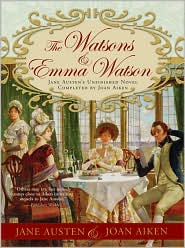
Pic: Cover to The Watsons & Emma Watson, by Jane Austen and completed by Joan Aiken, from Barnes & Nobles. I'd like to know if anyone has read it, and what you think of it?

Saturday, 11 July 2009

Jane Austen Quote - Week 64 by Linda


I picked up “Sanditon” again and found another treasure in Chapter 7:


I have read several of Burns's poems with great delight," said Charlotte as soon as she had time to speak. "But I am not poetic enough to separate a man's poetry entirely from his character; and poor Burns's known irregularities greatly interrupt my enjoyment of his lines. I have difficulty in depending on the truth of his feelings as a lover. I have not faith in the sincerity of the affections of a man of his description. He felt and he wrote and he forgot."


I had certainly heard of Robert Burns, the poet, but could not remember any specifics about the man or his works. So I went to Google to dig up some dirt on his character and ‘known irregularities’.


Miss Austen and I seem to have the same propensity to judge a writer’s works by his/her character. I like to know a bit about a writer as I read what she/he wrote. Well, I found the ‘dirt’. It appears that he was a bit free in his love life by bestowing his heart among several ‘ladies’. Miss Austen and I would hardly approve, I dare say. Therefore, we conclude it must have ‘tainted’ his works. Not only that, but also I noticed that he wrote with a Scottish accent, which I have a bit of trouble translating. Well, I have certainly been forewarned and shall take a bit of care if I happen to pick up a Burns book, or should that be “burns his book”? I shall leave it for you to determine! And please, do not think that I have any prejudices against the Scots, for I am part Scot myself. Any enlightenment you may have on this subject is most welcome.


Linda the Librarian


Pic: Robert Burns, from dontwastewine

Friday, 3 July 2009

Jane Austen Quote of the Week- Week 63

This week it is actually more a scene which I have chosen; it is a hilarious and truly adored scene from Pride and Prejudice and I dont believe we have included it in our quote of the week as of yet.

I have decided to quote parts of the scene where Mr Collins attempts to propose to Lizzy. One of my favourite elements is Mr Bennet's response to Mrs Bennet's stress. I have highlighted some of my favourite lines from the passages taken from this scene displayed below:

"Oh! Mr Bennet, you are wanted immediately; we are all in an uproar. You must come and make Lizzy marry Mr Collins, for she vows she will not have him, and if you do not make haste he will change his mind and not have her.''
Mr Bennet raised his eyes from his book as she entered, and fixed them on her face with a calm unconcern which was not in the least altered by her communication.
"I have not the pleasure of understanding you,'' said he, when she had finished her speech. ``Of what are you talking?''
"Of Mr Collins and Lizzy. Lizzy declares she will not have Mr Collins, and Mr Collins begins to say that he will not have Lizzy.''
"And what am I to do on the occasion? -- It seems an hopeless business.''
"Speak to Lizzy about it yourself. Tell her that you insist upon her marrying him.''
"Let her be called down. She shall hear my opinion.''
Mrs Bennet rang the bell, and Miss Elizabeth was summoned to the library.
"Come here, child,'' cried her father as she appeared. "I have sent for you on an affair of importance. I understand that Mr Collins has made you an offer of marriage. Is it true?'' Elizabeth replied that it was. ``Very well -- and this offer of marriage you have refused?''
"I have, Sir.''
"Very well. We now come to the point. Your mother insists upon your accepting it. Is not it so, Mrs Bennet?''
"Yes, or I will never see her again.''
"
An unhappy alternative is before you, Elizabeth. From this day you must be a stranger to one of your parents. -- Your mother will never see you again if you do not marry Mr Collins, and I will never see you again if you do.''
Elizabeth could not but smile at such a conclusion of such a beginning; but Mrs Bennet, who had persuaded herself that her husband regarded the affair as she wished, was excessively disappointed.
"What do you mean, Mr Bennet, by talking in this way? You promised me to insist upon her marrying him.''
"My dear,'' replied her husband, "I have two small favours to request. First, that you will allow me the free use of my understanding on the present occasion; and secondly, of my room. I shall be glad to have the library to myself as soon as may be.''

I love this brief window into the personality and character of Mr Bennet; it is enlightening. Jane almost keeps him in the shadows and then wham, he appears with the delivery of such classic lines. A fascinating character.

Slightly later in the scene, Charlotte Lucas has come to visit the family for the day and we get the completely contrasting and slightly imposting character of Mrs Bennet in full bloom!

"Aye, there she comes,'' continued Mrs Bennet, "looking as unconcerned as may be, and caring no more for us than if we were at York, provided she can have her own way. -- But I tell you what, Miss Lizzy, if you take it into your head to go on refusing every offer of marriage in this way, you will never get a husband at all -- and I am sure I do not know who is to maintain you when your father is dead. -- I shall not be able to keep you -- and so I warn you. -- I have done with you from this very day. -- I told you in the library, you know, that I should never speak to you again, and you will find me as good as my word. I have no pleasure in talking to undutiful children, -- Not that I have much pleasure indeed in talking to any body. People who suffer as I do from nervous complaints can have no great inclination for talking. Nobody can tell what I suffer! -- But it is always so. Those who do not complain are never pitied.''

The last line, "those who do not complain are never pitied" is actually the line which drew me to think of the whole scene. In the last few weeks I have been going to a series of interviews in search of a new job. I realised afterwards when the first few returned to me with disappointment that I did not want pity. I never want pity. So I continued to think only in a positive light and see the rejections as a chance to work on what I had done wrong. Yesterday I had an interview and I got the job which I am very happy about. So this line is very wise and something we should all adhere too.

Pic 1: Mr Collins

Monday, 29 June 2009

Once upon a “Bad Tuesday”

The following is Mariana’s companion article for the marvellous calendar that she had made earlier and I’ve posted here. Thank you so much, Mariana!

-xxx-

This is something I’ve started a while ago after reading Ellen Moody’s calendars. Like her I was trying to find patterns in Jane’s books, just that I was looking for them hoping to make the connection with Tom Lefroy –the dates and events that matched those from Jane’s surviving letters written in the years she met and ‘flirt’ with her “Irish friend”.

As per one of her articles, “A Startling Pattern: Bad Tuesday”, Tuesday seems to be “repeatedly a pivotal day in Austen's novels, a day on which some embarrassing or mortifying incident or series of incidents occurs (at a ball, a change of home) which sets off an important change in the plot.”


In P&P, the last ball at Netherfield during which Darcy becomes aware that everyone is saying Bingley will marry Jane and leads him to separate them, occurs on a Tuesday. There is a very similar event in S&S: the first traumatic day which is specifically named as Tuesday is the day when Marianne and her family expected Willoughby to make her an offer, but instead he comes to tell he’s been sent away to London by his reach aunt. Another book in which Jane chose to send away the gentleman on a Tuesday is Emma. Frank leaves Highbury on Shrove Tuesday but not before trying to confess to Emma his love for Jane and their secret engagement.

After reading Jane’s letters ‘between the lines’ and with the help of BJF JA/TL Timeline article, here’s my special calendar with all those pivotal Tuesdays I’ve found in her surviving letters.

In Jane’s first 2 surviving letters, one day gets mentioned repeatedly which happens to be a Tuesday: January 19th 1796, and I believe this was the day Tom Lefroy returned to London, after their last ball at Ashe, during which Jane was also expecting an “offer” (one reason to believe that Jane was talking about an offer in marriage is her statement: I mean to confine myself in future to Mr. Tom Lefroy” and that someone drew Tom’s picture for her):

1. On Sunday January 10 1796, Jane added few more lines to her 1st surviving letter which she started the day before. She talks about her cousins, the Coopers, but I believe this was more a sing of her disappointment in not having her sister home before Tom’s departure, and so not able to meet her “Irish friend”: “By not returning till the 19th you will exactly contrive to miss seeing the Coopers, which I suppose it is your wish to do.”

2. At the beginning of her 2nd surviving letter (January 14-16, 1796) Jane shows again disappointment in not having Cassandra coming home before Tom’s departure. She’s even telling her sister how little she cares about the ball that will be held when Tom is gone (I assume this one was on Friday like all previous balls): “I do not at all expect to see you on Tuesday, since matters have fallen out so unpleasantly; and if you are not able to return till after that day, it will hardly be possible for us to send for you before Saturday [January 23], though for my own part I care so little about the ball [January 22] that it would be no sacrifice to me to give it up for the sake of seeing you two days earlier.”


Another Tuesday I’ve discovered in her 1st surviving letter is the day she visited Mrs Lefroy at Ashe: January 5th, 1796.: “…he [Tom] is ashamed of coming to Steventon, and ran away when we called on Mrs. Lefroy a few days ago.” Most likely the visit took place after she sent her missing letter (January 2-4, 1796) and that’s the reason I think it was on Tuesday. By saying “few days ago” on Saturday morning, it means that more than 2 days passed since this visit.

This is matching again a Tuesday in P&P – the day when Miss Bingley writes to Jane inviting her for dinner at Netherfield Park. Probably the ball at Ashe has been confirmed, or announced during this visit (same as in P&P), after Jane sent her missing letter, and that’s the reason to have it communicated to Cassandra only on January 9th: “I can expose myself, however, only once more, because he leaves the country soon after next Friday [another reason to believe Tom’s departure probably took place onTuesday19th and explains Jane’s hopes to have her sister returning home till this date] , on which day we are to have a dance at Ashe after all.”


One more important Tuesday I’ve ‘picked’ from Jane’s letters is the day she spent in Cork Street –London, August (23) 1796, on the same street if not the same house, where Tom’s great-uncle Langlois lived. Although it can not be confirmed, I still believe this short letter and the missing one (25-29 August, 1796) sent from Rowling-Kent are related to Tom Lefroy. In the first letter we have from Kent, Jane apologizes for the length of her previous one “I am sorry that you found such a conciseness in the strains of my first letter” and promises to make amends for it when they will meet “by some elaborate details, which I shall shortly begin composing”. Jane sent 3 more letters to her sister before returning home, but none of them contained those secret details that I believe were referring to Tom Lefroy and her short visit in Cork Street. Most likely they’ve been communicated in person, as Jane mentioned, when she met Cassandra – an indication these details were not safe to be sent in a letter.

There are similar events in P&P and S&S: Jane Bennet is encouraged by her sister to go to London hoping she’ll meet Mr Bingley again, but instead she’ll send letters (the first one very short) filled with “elaborate details” about Miss Bingley’s plan to have her brother married to Georgiana Darcy: “an event which will secure the happiness of so many”. In S&S, the day Willoughby leaves his card, which Marianne sees when they come in form the morning's drive, it’s mentioned again to be a Tuesday -a week after their arrival in London. Also, the central traumatic moment wherein Willoughby humiliates Marianne at the ball is dated, as per Ellen’s calendar, on Tuesday January 16, 1798.


The last pivotal date for Jane and Tom’s story seems to be again a day when he returned to London after visiting Ashe, in November 1798. Most likely Tom’s departure was related to his brother’s “imprudent marriage” (November 5th, 1798 -reference JA/TL timeline) and probably it took place the day after the news reached them, on Tuesday 6th or Tuesday 13th –the day before Mrs Lefroy’s visit to Steventon (Wednesday November 14th).

This is again only an assumption but it just happens to be a very good match of a pivotal date in S&S: Tuesday November 7th, 1797 (as per Ellen Moody’s calendar) is the day when Willoughby has been sent away to London by his reach aunt. Between 6 and 7 November, Mrs. Smith had discovered Willoughby's affair with Miss Williams and demanded Willoughby marry her as price of her forbearance.


…and the link for a ‘matching video’ on YT: http://www.youtube.com/watch?v=0cYTRTOaW3k&feature=channel

All pictures belong to Mariana Gheorghe