Sunday, 1 April 2012

Tom Lefroy Quote Week 17

Please forgive the late instalment of this weekend. I was trying to find something from the Memoir of Chief Justice Lefroy, and – with my busy mind – it has proven difficult. But then, there it was. Page 196 just popped out for me; a letter to his wife, Mary Paul in July 1833.

“I have now been five successive nights keeping watch for our Church till near daylight. All that could be done has been and will be done. The Duke has worked nobly and is the most devoted friend to Ireland that I have found here; he has constantly spent three or four hours over the Bill in the mornings, and afterwards worked in the House for several hours. I spent nearly four hours to-day, completing the amendments to which we got the Government to accede last week, as they are to be all introduced in form on Monday, and on Wednesday the Bill will pass, improved in a great many respects, but with many mischievous provisions still left.”
By no means I try to imitate a Chief Justice’s schedule, nor I shall be that busy. But last week was very busy as well for me. I had a full week’s ofmeetings (ones that ended after the sunset) and – since I will have another big meeting in a few days – I was hoping that I did not have to work this weekend. But apparently I did, a few hours of meeting last night and another couple of hours this afternoon.

Forgive me, my dear friends. I didn’t mean to complain… I’m certain many of you have had busier weeks than mine last week. But sometimes I wish that I could have a healthier working pattern. It’s fine to be busy sometime… but being busy all the time is not healthy for body, mind and soul.

But. My holiday is coming soon in less than two weeks. I’m so looking forward for that, and I hope it will be a rejuvenating holiday for me.

How was your week last week, my dear friends? Busy? Or healthily steady? Any holidays to look forward soon? God bless you all.

Pic: Tom Lefroy, circa 1855

Thursday, 22 March 2012

Jane Austen Quote of the Week 188


Sorry this is early but I will be unable to post this weekend.

This quote is in honour of strong, "rational" women. It was our dear Icha's birthday this week so this quote is for her.

From chapter 8 of Persuasion, Frederick Wentworth is having a discussion with his sister Sophia (and her husband the Admiral) about whether women should travel alone on board a ship.


He begins:

"But, if I know myself,' said he, 'this is from no want of gallantry towards them. It is rather from feeling how impossible it is, with all one's efforts, and all one's sacrifices, to make the accommodations on board such as women ought to have. There can be no want of gallantry, Admiral, in rating the claims of women to every personal comfort high, and this is what I do. I hate to hear of women on board, or to see them on board; and no ship under my command shall ever convey a family of ladies anywhere, if I can help it.'

Later on she retorts:

'But I hate to hear you talking so like a fine gentleman, and as if women were all fine ladies, instead of rational creatures. We none of us expect to be in smooth water all our days."

Yes I think that some choppy waters can be the spice of life!


Happy Birthday Icha.


Pic: JASNA

Monday, 19 March 2012

Austen film Memorabilia For Sale!


The Jane Austen Centre newsletter has made us aware of an exclusive auction now on ebay of original costumes from some of Jane Austen's film adaptations. They were chosen to host the eBay auction for the celebrated BAFTA and EMMY award winning costume designer, Andrea Galer.


The auction began a few days ago and ends next Sunday 25th March. Worldwide postage is available!


Included are costumes from Persuasion and Miss Austen Regrets, plus two 'Mr Darcy' (Matthew MacFadyen) waistcoats.


View the auction here


Pic: from the ebay auction

Sunday, 18 March 2012

Jane Austen Quote of the Week 187


I have been bombarding myself with ‘Downton Abbey’ lately, including the basic circumstances that required Lord Grantham to invite Matthew Crawley to Downton (because his previous heir died during the Titanic accident, God bless their souls). I then remembered how similar things still were in 1912 with early 19th century when Jane Austen wrote Sense & Sensibility and Pride & Prejudice. Just take a look at a paragraph from SS Chapter 1 Volume 1:

The old Gentleman died; his will was read, and like almost every other will, gave as much disappointment as pleasure. He was neither so unjust, nor so ungrateful, as to leave his estate from his nephew; - but he left it to him on such terms as destroyed half the value of the bequest. Mr Dashwood had wished for it more for the sake of his wife and daughters than for himself or his son:- but to his son, and his son’s son, a child of four years old, it was secured, in such a way, as to leave to himself no power of providing for those who were most dear to him, and who most needed a provision, by any division of the estate, or by any sale of its valuable woods.

Thus Mrs Dashwood and the girls had to leave Norland, but thankfully not without meeting Edward Ferrars first (at least for Elinor’s sake).

And of course, in PP, we have Mr Collins, who, as Mr Bennet said in Chapter 13 Volume 1, “…when I am dead, may turn you all out of this house as soon as he pleases” to which his dear wife replied with “Oh! my dear…I cannot bear to hear that mentioned. Pray do not talk of that odious man. I do think it is the hardest thing in the world that your estate should be entailed away from your own children; and I am sure if I had been you, I should have tried long ago to do something or other about it.”

All of these conversations gave me a very strong desire to understand why the entail had to be designed as such to put women in such a disadvantage situation. I think it has been enacted since early 13th century. Pemberley has a link about an entail, including a very complicated Male Primogeniture Succession that explained that any entailed properties were inherited by the nearest male-line descendant (instead of female line).

My primary question is, is it still happening? If not, when did it cease? If it is, I cannot believe it. England is a modern country after all, now. But… even in Indonesia, inheritance is given to the eldest son, not daughter, until now. So why am I still surprised?

Rachel &c, care to explain it to me?


Pic: Norland Estate, from Jane Austen's World

Sunday, 11 March 2012

Jane Austen Quote of the Week 186

My quote for Jane will be a melancholy remembrance because a very dear Aunt of mine passed away two days ago. I go to attend her funeral on Saturday, the 10th. I wanted to find something that affected Jane to reflect the way I am feeling now. So, in her letter dated Monday, January 21, 1805 she wrote the following to her brother Francis Austen:

"I have melancholy news to relate, & sincerely feel for your feelings under the shock of it. I wish I could better prepare you for it. But having said so much, your mind will already forestall the sort of event which I have to communicate. Our dear Father has closed his virtuous & happy life, in a death almost as free from suffering as his Children could have wished. ....... Heavy as is the blow, we can already feel that a thousand comforts remain to us to soften it. Next to that of the consciousness of his worth & constant preparation for another World, is the remembrance of his having suffered, comparatively speaking, nothing. Being quite insensible of his own state, he was spared all the pain of separation, & he went off almost in his Sleep. My Mother bears the Shock as well as possible; she was quite prepared for it, & feels all the blessing of his being spared a long Illness."

Jane's words also apply to my dear Aunt, which brings me some comfort. Also, please note the date, January 21, 1805 and remember that Jane had also lost a dear friend, Mrs. Anne Lefroy in December, 1804. My heart goes out to her.

Yrs aff'ly,
Linda the Librarian

Pic: George Austen, Jane's father

Thursday, 8 March 2012

"Jane Austen"

One of our blog readers has emailed us wanting to share her fantastic song about Jane.

Holly Christina dedicates her song to Jane Austen fans everywhere. It is available on iTunes also.

See it here


Pic: Elizabeth and Mr Darcy in Pride and Prejudice

Wednesday, 29 February 2012

Jane Austen Quote of the Week 185

When in doubt of what to chose for a quote to post I always turn to Sense and Sensibility for inspiration. The relationship between Elinor and Marianne has always been a fascinating connection for me. I dont have any brothers or sisters so I suppose it always led me to wonder what it would have been like to have a sister.


Anyway I have chosen a quote from the part in the novel when Marianne has found out about Elinor's love and near-heartbreak for Edward.


From chapter 37:


"How long has this been known to you, Elinor? has he written to you?"
"I have known it these four months. When Lucy first came to Barton Park last November, she told me in confidence of her engagement."
At these words, Marianne's eyes expressed the astonishment which her lips could not utter. After a pause of wonder, she exclaimed -
"Four months! - Have you known of this four months?"
Elinor confirmed it.
"What! while attending me in all my misery, has this been on your heart? and I have reproached you for being happy!"
"It was not fit that you should then know how much I was the reverse."


Elinor makes a habit of concealing her feelings and no one knows what she is really feeling, not even her closest confidants. As Marianne was showing her devastation over losing Willoughby, Elinor was helping her feel better and tending to her every need. This important conversation marks a turning point in the story when finally both sisters have confided in each other and their problems begin to slowly get better.


Have you ever had to be the strong one in a relationship, listening to anothers sorrow whilst you are crying inside?
Or perhaps you have confided your emotions with a close friend or family member without really having any idea of what they are going through themselves?


I think that we may all have been either Marianne or Elinor at some point.


Sunday, 26 February 2012

Jane Austen music on radio!

Lily Miceli of 'InBetween The Music' has a radio show on a community frequency off of a WPR/NPR station in Wisconsin. Her shows are an hour with a theme that includes music,history and a bit of trivia.

One of her first shows was done on the music of Jane Austen. You can hear that show and others on her website. The show is listed near the bottom. Please go to http://www.inbetweenthemusic.blogspot.com.

Thanks Lily for the info. Ladies and Gents, enjoy!

Jane Austen Quote of the Week 184

I never cease to be amazed "how things never change." Every time that I think we have made some progress and things are "new" or "better" I find something in Jane's writings that describe things or people in her day that are the same as in today's world. Here is a for instance from her brother's periodical "The Loiterer" number 22:

My Readers can have no idea of the multifarious Amusement, which a Course of Reading of this kind will afford. They will find the utile, the dulce, the Turpe, all blended together into a curious Medley. In a corner of the same Paper, which contains the strenuous exertions of the Supporters of the Bill for the Abolition of the Slave Trade, of Sir Joseph Andrews, Dr. Hawes, and the Humane Society, for the comfort and preservation of mankind — the diabolical Assassin of the human species in Embrio, to the eternal disgrace of the Police of Great Britain, is permitted to hold out an infamous temptation to the basest of Murders: At the same time professing, that the strictest delicacy, honour, and secrecy, will upon every occasion be observed.

This issue is basically about advertisements in the newspapers. What astonished me was the inclusion of 'abortions' - as we call it today. I had no idea that such things were going on way back then. Sigh, the things I learn by studying all things Austen! You may read the entire issue HERE.

Linda the Librarian

Sunday, 19 February 2012

Tom Lefroy Quote Week 16


For this weekend, I choose a quote from the Memoir of Chief Justice Lefroy which reminds me of simple but important things: family and union (marriage, I guess)(p. 134). The letter was to his wife (Mary Paul), dated 5th June 1841. In the beginning, he talked about the parliamentary vote that happened recently, but later he talked of this:
“… We have the greatest of earthly treasures in the bond of family love and union with which we are blessed, and this not as a gift of earth but sent down from heaven. As soon as I can I shall rejoice to spread my wings and to flee away to dear home.
T.L.”
I think Linda would love this quote. You always see Tom as a family man, don’t you, dear Linda? As for me, I’m doing overseas Skype with my significant other and also enjoy the fresh scent of my newly mopped home.
Enjoy the rest of your weekends, my dear friends.
Pic: Thomas Kinkade’s ‘Village Lighthouse’ (I LOVE his artworks!)

Friday, 10 February 2012

Jane Austen the Unseen Portrait - an alternative theory ...

We made a post a month ago (view here) which proposed that the new portrait found and owned by Dr Paula Bryne is actually Jane Austen.


I have received a detailed email from Chris Brindle who is related to the portrait painter and topographical recorder of the Hampshire scene, R.H.C. Ubsdell (1812-1887). I am going to present the information below.


The 'unseen' portrait is thought to have been created from life in London around 1816 by an artist of moderate abilities. Although it is acknowledged that Paula may be correct in her assumptions, given that the work of art is this old, there must leave some room for conjecture, so Chris would like to offer another possibility. The documentary made the point that the picture fits Anna Lefroy’s description exactly, so he believes it could be exactly that, a picture produced to the recollection of Anna, most probably in 1833.

Chris has actually seen Anna Lefroy’s diary and this places Anna at a house in the grounds of Oakley Hall (see 1st picture above) for a period from 1831 until 1833 and again for a period between 1840 and 1849.


As we know Anna Lefroy was the first child of eldest Austen son, James, by his first wife Anne Matthew. On her mother’s early death, when Anna was two she spent a lot of her early life at Steventon with Aunt Jane. Anna went on to marry Ben the youngest of the Leforys of Ashe. Ben did not take holy orders initially and it seems probable that Ben claimed he could make a living as an artist, and Anna claimed she would make a living as a writer like Aunt Jane. Jane had written her play 'Sir Charles Grandison' as an entertainment for Anna, they had talked about the characters of Pride & Prejudice as if they were real people, and on the brink of married life with Ben Lefroy, Anna embarked on her first attempt at writing 'Which is The Heroine' which was ultimately to be thrown on the fire in frustration sometime in the early 1820s. It is Jane's letters giving her comments on this attempt which tell us so much about Jane's own attitude to writing.

Anna’s house in the grounds of Oakley Hall was most probably the Garden Cottage of the present hotel, and it was here Chris believes that Anna finally plucked up the courage to become a writer like her Aunt Jane. Her short story 'Mary Hamilton' was published in the Literary Review of 1833, the same year Austen's novels came back into print in the Bentley Standard Editions. Anna had to vacate Oakley Hall on the death of its owner Wither Bramston in 1833, and Chris postulates that it had been Wither who had supported Anna in her writing to the displeasure of Wither’s wife Mary, sister of William Chute of the Vyne. William and his wife Eliza had strong connections with the Austens; James (Anna's husband) had hunted with the Vine Pack and Anna’s half brother James Edward Austen (Leigh) married Eliza’s niece.


Is it possible that Anna had an artist produce the image of Jane Austen from her recollections with a view to 1) making a link with Jane Austen, 2) justify women as professional writers, 3) illustrate the forthcoming Bentley editions, 4) reestablish favour with the family of William Chute?


Upon her return to her house in the grounds of Oakley Hall in 1840, Anna again found the ability to write. 'The Winter's Tale' was published in 1841 and 'Springtide' in 1842. Most importantly, it was here in 1845 that she wrote her continuation of Austen's last and unfinished novel Sanditon having received the manuscript following Cassandra’s death early that year. Her continuation was finally published in America in 1983. Finally in 1845 Anna found courage to be recorded as a writer, shown sitting at her writing desk in R.H.C. Ubsdell's tiny portrait miniature of her completed in the October of that year. This pose has remarkable similarities with the ‘unseen portrait of Jane’.

Chris Brindle believes that it was Ubsdell who produced the 1833 picture because he knew of Anna’s struggle as a writer. Ubsdell was known to have sketched Anna back in 1833 because he included her in his picture, “Sermon at St Lawrence” (see 2nd picture below). In this allegorical work Ubsdell uses the images of the famous people he has painted, to create a scene of people sitting round the smallest church in the country listening to a sermon by Samuel Wilberforce. Ubsdell portrays his patron Charles Richard Sumner Bishop of Winchester as a shepherd leaning on his shepherd’s crook, whilst Anna holds her hand on his as if seeking his guidance.

In his early years Ubsdell had an art gallery and studio at 135 High Street Portsmouth, England, opposite the theatre. He became very successful with the advent of photography and in 1859 moved to possibly the best house in Portsmouth, 1 Green Row. He became the local artist of choice for the rich and famous passing through Portsmouth. Portraits of Sir Francis Austen and Charles Austen are also probably by him. It is likely Ubsdell was selected for the retrospective Jane Austen picture in 1833 because in that year he had exhibited at the Royal Academy for the first time.

There could also be other Ubsdell pictures of the Austen family. The miniature painting of Sir Charles Austen (done surely in England in 1846 rather than Malta in 1850) at Chawton Cottage is remarkably similar in size, shape and style to the Anna Lefroy miniature, and the admiral in 'The Royal Navy No 2' aquatint in the National Maritime Museum based on an Ubsdell watercolour, bears a remarkable similarity to the Francis Austen portrait, plate 5 in Southam's 'Jane Austen & The Navy'.


What do you think? I have been reliably informed that he “unseen” picture of Jane Austen, owned by Paula Byrne, which featured in the recent documentary, is to go on exhibition at Chawton Cottage at Easter for a period of six months so any of you able to make a visit, I think it will be well worth it to make your own judgement.


Any comments welcome ...


If anyone would like to contact Chris Brindle for more information, his email address is brindlechris@aol.com. He does have a key to who everyone is in the “Sermon at St Lawrence”, and a note of other picture references to the people involved. He also has information about the likely materials used for the portrait.


Pics: Sent to me by Chris Brindle

Jane Austen Quote of the Week - Week 183

This weeks quote is in honour of Valentines Day which is fast approaching us, next Tuesday 14th February.


You know that we, here at the Becoming Jane blog, are always trying to find evidence of the true love between Jane Austen and Tom Lefroy. We are romantic souls who believe...know... its true!


I have chosen a slightly different choice for this weeks quote as it is actually a quote within a quote. From chapter 9 of Emma when Mr Elton has just left 'the' letter with Harriet and Emma. Emma is convinced that the letter was intended for Harriet and she is speaking to encourage Harriet of his true affection for her:


"You and Mr Elton are by situation called together; you belong to one another by every equal match to the match at Randalls. There does seem to be a something in the air of Hartfield which gives love exactly the right direction, and it sends it into the very channel where it ought to flow.
The course of true love never did run smooth ---
A Hartfield edition of Shakespeare would have a long note on that passage."


The bolded line of the quote is actually from Shakespeare's 'A Midsummer Night's Dream' but I feel it is poignant. It is interesting to me that when Jane was reading Shakespeare's play this line obviously came out from the page and stuck in her mind. Why I wonder?


Jane and Tom first met 18 years before Emma was written. Is it possible that she comforted herself with the thought that their love was indeed true but that true love is never as smoothly played out as we are led to believe from fairytales?


True love certainly does exist but sometimes life can get in the way and so although it is felt for a lifetime and never forgotten, only the lucky ones get to spend their whole life with their other half.


Have a wonderful Valentines Day everyone!


Gone Reading - update

In November of last year I made a quote about a wonderful organisation called Gone Reading,


They have Austen themed gifts, amongst others, and all profit goes to charity.


Gone Reading is based in the US with free shipping if the order is over a certain amount.


There is currently a 25% off coupon for the readers of our blog which expires 10 March.


Visit Gone Reading website


Simply add BECOMINGJANE25 into the checkout and your discount will be applied.


Happy shopping!


Pic: Taken from the website

Sunday, 5 February 2012

Jane Austen Quote of the Week 182

A couple of weeks ago I got 'hooked' on the subject of LOVE in "Mansfield Park", so now I will continue there in Chapter 38 today:


Fanny’s immediate concerns, as far as they involved Mr. Crawford, made no part of their conversation. William knew what had passed, and from his heart lamented that his sister’s feelings should be so cold towards a man whom he must consider as the first of human characters; but he was of an age to be all for love, and therefore unable to blame; and knowing her wish on the subject, he would not distress her by the slightest allusion.

Fanny's brother, William was being kind though he 'mistakenly' thought Mr. Crawford worthy of his sister, he bowed to her wish for "love". What I have discovered is that my copy of "Mansfield Park" is filled with highlight markings. I stand amazed at all the wonderful knowledge of worldly life that Jane had in those days. I guess we are not as smart as we thought, and they are not as 'dumb' as we thought. Always willing to learn, I remain,

Yrs aff'ly,
Linda the Librarian

Pic: A cover of
Mansfield Park

Sunday, 29 January 2012

Tom Lefroy Quote Week 15

I wanted to find a Tom quote that would reflect the birthday of our lovely Linda, who will be 71 years old tomorrow Monday. From the Memoir of Chief Justice Lefroy page 329, an excerpt from Lord Derby (Prime Minister Edward Smith-Stanley, the 14th Earl of Derby) to Chief Justice Lefroy:

Downing Street,

July 11, 1866
“My dear Chief Justice, - Your son sent me, a few days ago, a most kind letter from you, the handwriting of which I should have taken to be that of a man of thirty instead of ninety, in which you express your readiness to surrender into my hands the high office which I had the satisfaction of intrusting to you fourteen years ago, and which you have filled with so much credit to yourself and advantage to the public service.”

That’s what I often feel when I communicate with Linda… Not exactly 30-90, but I often forgot that she is already 70 years old, and going to be 71 years old tomorrow. Linda still has her sharp mind and alert consciousness, something to be admired from people of her age.

Thank you for helping us these years, Linda. Have a happy birthday, may you be happy, healthy and prosperous always. God bless you.

Pic: Edward Smith-Stanley, Wikipedia


Sunday, 22 January 2012

Jane Austen Quote of the Week - Week 181

I chose a part of Pride and Prejudice that I love - chapter 43 when Elizabeth sees Pemberley for the first time. It triggers the beginning of her growing affection for Mr Darcy. She later meets him in the grounds and they connect like they havent before.

"They gradually ascended for half a mile, and then found themselves at the top of a considerable eminence, where the wood ceased, and the eye was instantly caught by Pemberley House, situated on the opposite side of a valley, into which the road with some abruptness wound. It was a large, handsome, stone building, standing well on rising ground, and backed by a ridge of high woody hills;—and in front, a stream of some natural importance was swelled into greater, but without any artificial appearance. Its banks were neither formal, nor falsely adorned. Elizabeth was delighted. She had never seen a place where nature had done more, or where natural beauty had been so little counteracted by an awkward taste. They were all of them warm in her admiration; and at that moment she felt that to be mistress of Pemberley might be something!"

I really love the part "nature had done more" and "natural beauty had been so little counteracted by an awkward taste" - what a wonderful description and I think that this can be linked to the natural development of her relationship with Mr Darcy.


Pic: Elizabeth Bennet at Pemberley

Monday, 16 January 2012

Jane Austen the Unseen Portrait


Thanks to Mariana Georghe, here we are aware of the 'new' unseen portrait of Jane Austen. The clip is from BBC, but is now in SMaryG's YouTube account. The picture was found by Dr Paula Bryne and was later discussed in the recent BBC documentary titled 'The Unseen Portrait of Jane Austen?'.

A detailed article about this portrait can be found here.

I have to say that the picture does not match to my personal image of hers, which was more influenced by the sketches made by Rice and James Stanier Clarke (we discussed them here and here). The Rice and Clarke sketches displayed the frontal view of the young girl's faces, hence I was led to believe that the nose would not be so pronounced, as in the Bryne portrait.

But the facial features does speak of the talented, witty woman we know as Jane Austen. So... who knows?


Pic: Dr Paula Bryne's found portrait of Jane Austen.

Jane Austen Quote of the Week - Week 180

Let's get serious for a minute this week and talk about LOVE and MARRIAGE. In Mansfield Park, Chapter 35 we find a discussion between Edmund and Fanny concerning Fanny's recent rejection of Henry Crawford's proposal of marriage. Edmund had just returned home and heard the news of the proposal. He wished to discuss her feelings about the matter so he joined her in a walk through the shrubbery.


Fanny, at one agitated and dejected, replied, "IF you hear of it from everybody, cousin, there can be nothing for me to tell."
Not of facts, perhaps; but of feelings, Fanny. No one but you can tell me them. I do not mean to press you, however. If it is not what you wish yourself, I have done. I had thought it might be a relief."
"I am afraid we think too differently for me to find any relief in talking of what I feel."
"Do you suppose that we think differently? I have no idea of it. I dare say that, on a comparison of our opinions, they would be found as much alike as they have been used to be: to the point - I consider Crawford's proposals as most advantageous and desirable, if you could return his affection. I consider it as most natural that all your family should wish you could return it; but that, as you cannot, you have done exactly as you ought in refusing him. Can there be any disagreement between us here?"
"Oh no! But I though you blamed me. I thought you were against me. This is such a comfort!"
"This comfort you might have had sooner, Fanny, had you sought it. But how could you possibly suppose me against you? How could you imagine me as advocate for marriage without love? Were I even careless in general on such matters, how could you imagine me so where your happiness was at stake?"


So the crux of the matter is this: one should marry for LOVE and is of the utmost importance. Certainly there are other things to consider, but love is to be considered FIRST. Speaking as one who has "been there, done that" I can vouch for the correctness of such advice. I only wish I had tended to those "other things to consider" a little more carefully. As we say "too soon old, and too late smart". Sigh.


Yrs aff'ly,


Linda the Librarian


Pic: Fanny Price

Sunday, 8 January 2012

Jane Austen Quote of the Week 179 by Linda

While tiding up my cluttered desk I ran across a scribbling dated for 2-21-09, but cannot find that I actually posted it. So I shall give it a try now.

It is from Mansfield Park, Vol. 3, Chapter 5 of my Signet Classic edition, where Miss Crawford made a request of Fanny:

Her [Fanny's] habits of ready submission, on the contrary, made her almost instantly rise and lead the way out of the room. She did it with wretched feelings, but it was inevitable.

I couldn't help but notice this character trait of "ready submission" when anyone makes a request. It simply must be done. It is a trait that has been passed down through the ages, because I have observed this very trait in my own Grandmother, as well as myself. I will also add that it is fostered in our Bibles as "wives be obedient to your husband's will". I have since learned that "ready submission" is not the way to go. But that's another story.

This is just one example of how Jane throws in so many small things that we can relate to. For instance, when I opened my copy of MP, I noticed all the notations I had made. There is enough material for a ton of quotes. So reader beware! Here I go!

Linda the Librarian

Pic: Cover to Oxford World's Classics of Mansfield Park

Sunday, 1 January 2012

Jane Austen Quote of the Week - Week 178

Firstly Happy New Year to you all and thank you very much for your continued support. If any of you have any suggestions on Jane-related things we can do this year on the blog then please do write to us.

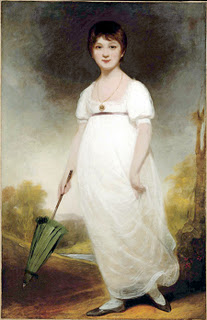
Linda has kindly made me aware of a website that we wanted to bring to your attention. It provides information about The Rice Portrait of Jane Austen.
Before I continue I want to link this to a fantastic article that Icha wrote here on the blog in July 2007 about this very same topic Rice Portrait and Clarke's Sketch. Basically it is believed that the 'Rice Portrait’ refers to a portrait of a young girl made by Ozias Humphry, an English painter (1742-1810). It is proposed that the portrait is of Jane Austen when she was around 13/14 years old but there has been much debate about the authenticity of this portrait.

The website mentioned above, The Rice Portrait of Jane Austen, has recently been constructed by Anne Winston Rice who was married to Henry Rice, a descendent from Jane. She wants to set the record straight about whether this portrait is indeed Jane Austen, she believes it is.

The website is quite detailed and I will not try to summarise all the information here as it is well worth exploring yourself if you are interested. She describes 4 pieces of primary evidence which puts together an excellent case. I have simplified the information below:

- Colonel Thomas Austen, Jane's second cousin, had possession of the painting and gave it to his great friend Colonel Thomas Harding-Newman in 1818. Colonel Harding-Newman’s son wrote in 1880: “I shall hope to give another painting of Jane Austen to her relative Morland Rice. It is of a girl about 15, and came into my family the gift of Colonel Austen of Kippington, to my mother-in-law, or rather, step-mother, my father’s second wife, who was a great admirer of the novelist."

- Admiral Sir Francis Austen, Jane's brother, was very close to his grandson John H. Hubback and it is believed he shared valuable information regarding the Rice Portrait with him. Hubback told Mrs Graveson (a lady researching the portrait) that his cousins, the Rices, owned the only professionally executed painting of the authoress.

- Lord Brabourne was the eldest son of Fanny Knight, who married a Knatchbull Hugesson. He was Jane Austen’s great nephew, as also were John Hubback and Morland Rice. They were all cousins. In 1884, he published the first book about Jane, her “Life and Letters”. He relates how he has written to Mr Cholmeley Austen-Leigh about Morland Rice’s portrait, and that Mr Cholmeley Austen-Leigh has replied that if Morland’s portrait is authentic.

- Fanny Caroline Lefroy, the granddaughter of the Rev. James Austen was the family historian. Her mother, Anna Austen had lived in the same house as Jane Austen for some ten years, and therefore would have known what she looked like. Morland Austen, who received the portrait, asked Fanny Caroline Lefroy for her opinion about the portrait. She says she “knew before of the portrait in your possession”, and cites one or two little difficulties but only of when, and where, the portrait was painted.

Pic: Taken from Jane Austen Rice Portrait